

There is a lot of FUD in the market about ultra high power (UHP) lasers for CPO and who the leading provider is in this segment. Everybody I’ve asked about UHP lasers unequivocally says Lumentum is in the lead, but few are able to discuss the engineering challenges in making UHP lasers, where the Lumentum advantage lies (if it even exists), and what the real alligator-filled moat is that keeps competitors out.
The goal of this article series is not to dethrone Lumentum or advocate for an alternative provider in any way. It is to understand the true difficulty of making UHP lasers for CPO from first principles, so that the reader is well informed enough to cut through the noise and think for themselves.
Instead of examining generic laser architectures, we will directly address the one that Lumentum says their structure is most similar to, in their CLEO 2022 paper.

In their CLEO 2022 paper, it seems interesting that Lumentum would quote a paper from 2007 as the basis for their high power laser design. These authors at the time were affiliated with JDS Uniphase, which spun off in 2015 to become the publicly traded, and well loved company that we know as Lumentum today.
Interestingly, none of those authors work at Lumentum any more. Another important takeaway is that Lumentum has been working on UHP lasers since before they were Lumentum. As it turns out, 20 years later, this precise laser architecture is what the world wants for CPO and Lumentum just happens to have a ton of experience with it.
This 2007 paper describes a 1310 nm InGaAsP/InP DFB doing 600 mW on-chip and 350 mW ex-fiber with sub-500 kHz linewidth, and is spec-for-spec the ancestor of the UHP laser Lumentum sells for CPO today. We’ll use this as a case study to understand UHP lasers and how its related challenges were solved, but is still by no means an endorsement for investments in Lumentum. Do your own research.
To understand how to make a good UHP laser requires a background in how these devices work. This first part is groundwork: how an InP DFB laser works and the physical walls that make high power hard. Where Lumentum’s advantage actually lies, and how deep the moat runs, needs this physics first, so that verdict waits for Part 2.
Contents:
InP laser diode fundamentals
Multiple Quantum Well structure
L-I curve, spontaneous vs stimulated emission
Distributed Feedback (DFB) grating design
Mode-hopping
How to space gratings
How DFB works
Refractive index changes
Reflection strength and length
Laser Linewidth and DFB Cavity Length
Calculating linewidth: Schawlow-Townes-Henry equation
Impact of power, mirror loss and dependence on length
Low Power DFB Lasers for Telecom/EML
Direct modulated lasers (DML)
CW lasers and EMLs
High Power DFB Lasers for CPO
How to increase output power
The 4 walls of UHP lasers
Heat
Linewidth widening
Getting light out
Catastrophic optical damage
By reading this post, you agree to the terms and conditions. Also see the full ethics statement.
If you are not a paid subscriber, you can purchase just this article using the button below. You can find the whole catalog of articles for purchase at this link.
If you would like to engage boutique research services for your project, reach out to us.
The Indium Phosphine (InP) Distributed Feedback (DFB) laser is the fundamental component of optics today, so it is best we understand how it works. It consists of two basic parts built on the same piece of material: The InP laser diode and DFB grating.
The InP laser diode
This is often called the gain section and its job is to convert electrical current into optical power. The light is generated by Multiple Quantum Wells (MQW) in an “active region” which are essentially alternating layers of InGaAsP (Indium-Galium-Arsenic-Phosporus) sandwiched together. The alternating layers have slightly different compositions of these fundamental elements, so that they have slightly different energy levels. The purpose of this structure is to trap electrons in a low-energy layer between two high energy layers so that the electrons are trapped in a “well” and can’t get out. Multiple wells means more electrons, which means stronger laser output.
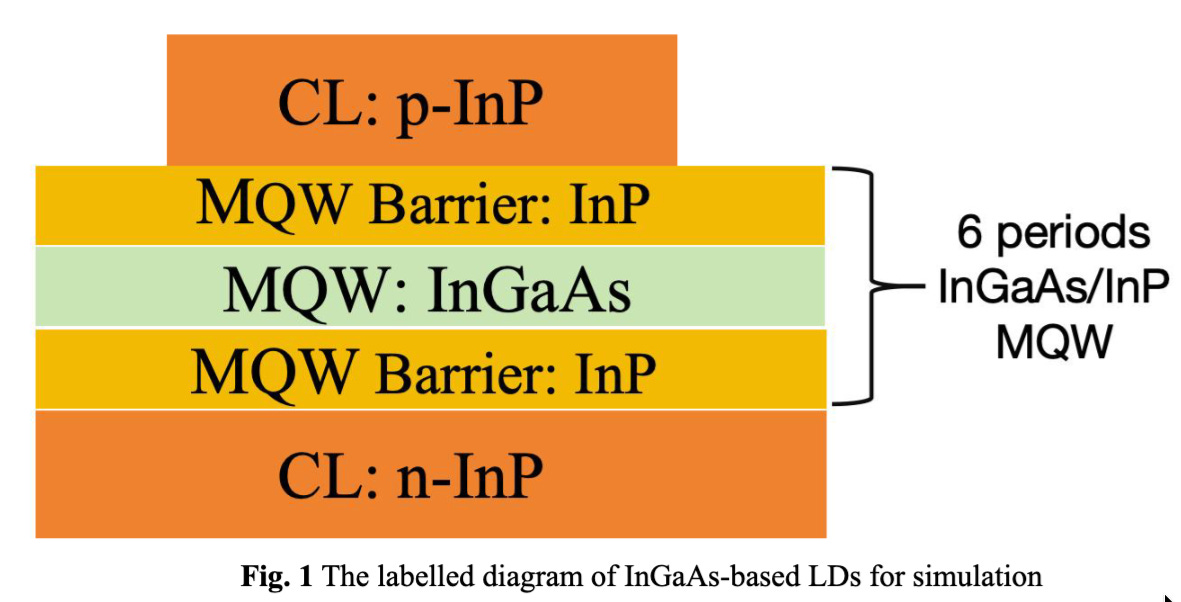
Source: Effects of multiple quantum well width on InGaAs/InP laser diode, doi:10.1088/1742-6596/2937/1/012007. (link)
If you want to understand more about what energy levels in a semiconductor mean, I have several articles on this.
The Joy of Semiconductor Devices

Transistors are really wonderful little things that have changed our lives in countless ways. Semiconductors are so pervasive in our society that it helps to have a basic understanding from first principles. But textbooks are hard.
To generate light, current is applied to the laser diode by applying a voltage across the anode and cathode. When the current applied is low, the emission of light is a messy stream of light waves out of phase with each other, each one behaving independent of the other. This is called spontaneous emission, and is not a focused beam of light; it is much like LED light. If photons were people, they would just wander around in a park without purpose.
Beyond a threshold of current, stimulated emission kicks in. The photons generated in the presence of a highly concentrated “well” of electrons kick up more photons themselves resulting in an avalanche of more photons. These photons now march in step with their phases correlated to each other. Now the photons are on a military parade in complete lockstep while being highly directional and focused.
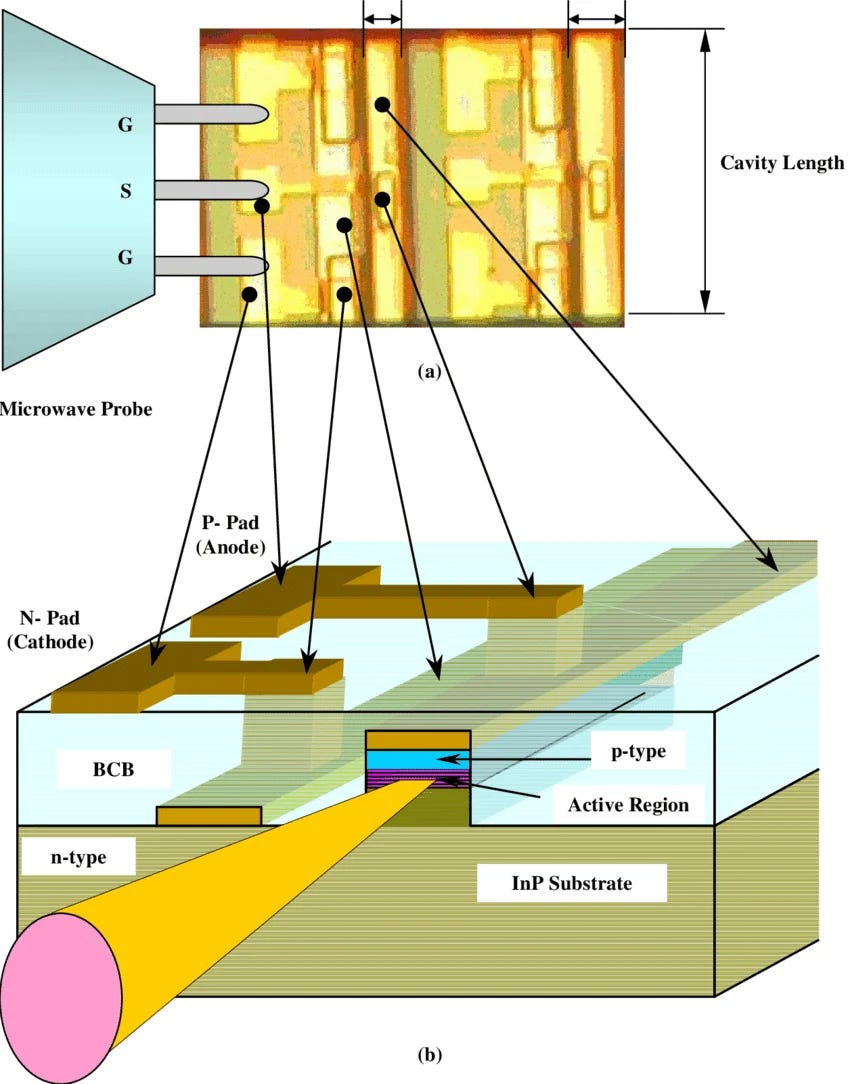
Source: Wide-Band and Scalable Equivalent Circuit Model for Multiple Quantum Well Laser Diodes, Jae Hong Kim, PhD Thesis, Georgia Tech 2005.
This relationship between light and applied current is represented by the L-I diagram shown below. The threshold of current needed to make photons march together depends on the temperature; higher temperatures need more drive current. This is an important observation that will later drive a lot of our understanding of UHP lasers.
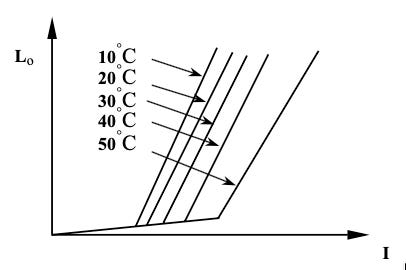
Source: Wide-Band and Scalable Equivalent Circuit Model for Multiple Quantum Well Laser Diodes, Jae Hong Kim, PhD Thesis, Georgia Tech 2005.