

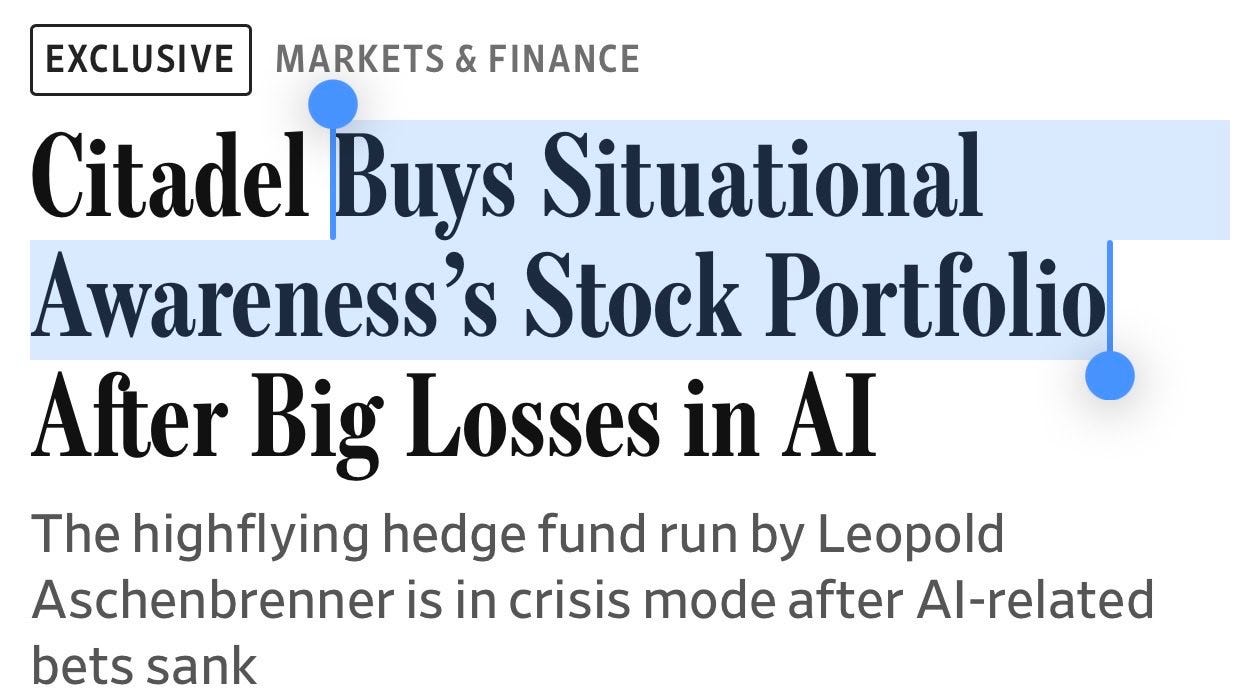
This week was an investor nightmare come true: the boogeyman is finally here, and the AI trade unwound. The Situational Awareness story is the most reported story this week, and it is worth following what happened if you are not already informed. We’ll tell the story here, and what may happen going forward.
By reading this post, you agree to the terms and conditions. Also see the full ethics statement.
Also check out the Semi Doped podcast with Austin Lyons and myself, and our daily free newsletter with latest semi news. If you would like to engage independent research services for your project or need expert calls, check out my boutique consulting practice at SemiExponent.
Are you aware of the Situation?
Situational Awareness (SA) is a hedge fund run by ex-OpenAI upstart Leopold Aschenbrenner whose entire view on the AI trade is “hyper-bullish” to put it mildly. Their sole premise of investment is — AGI is here to swallow the world, and nothing short of it. In the era of bottleneck trades that we have been in the midst of for the last two years, this premise worked swimmingly, with the fund posting over 2,000% gains.
They did so with an insane amount of leverage — like 4x, where leverage is basically borrowing to invest, and not putting down your own money. You can make a lot of money with leverage, but when things go south like they did this week, you can also lose a lot of money. We’ll get to that.
SA become a global and FinX phenomenon, where everyone was waiting to see what they were investing in. Their 13F filings were more awaited than a Taylor album for a Swiftie. There were plenty of copy traders who waited to see what SA invested in and bought the same stocks. I imagine some of them were even more levered than SA because (a) blind faith/greed, and (b) they were not as early as SA, and had to “catch up.” More leverage = more money, especially if you already had bought into the “AGI is here and nothing else matters” kool-aid.
The Storm was Brewing
But the perfect storm of events were already brewing; one that you can probably only tell in hindsight.
SK Hynix’s stellar numbers came in below consensus (a word the Street uses to mean “we all believe this is how much they will make in earnings”) — a sign that expectations had gotten ahead of reality
China announced they are putting immersion DUV in production — this does not change anything immediately.
CXMT IPO-ed and got a massive boost with people believing they will flood the market with cheap memory — they can make DRAM, not cutting edge HBM, and they definitely do not have capacity to supply the entire world with memory.
Everybody getting very skittish about the amount of debt that the infrastructure companies had taken on.
There is one more factor that deserves its own section later, but let’s (briefly) talk about this debt: even earlier this week, there were fears that infrastructure builders are not going to be able to repay their debts if all the CapEx investments do not turn into revenue. Not to mention all the circular financing deals going on, where Nvidia is investing money into their own customers, and many more complex dealings tied to tranches of stocks vesting when they hit certain prices. It’s nuts, I agree, and hard to keep track of.
Anyway, investors often buy Credit Default Swaps (CDS) when they believe that companies will not be able to repay their debt; think of it as insurance against a bad investment. When this insurance premium goes up, you know that more people believe that companies will default of their lines of credit. CDS premium spreads were what what gave away the subprime mortgage crisis of 2008-2009 too, but at the time, they were insuring against Mortgage-Backed Securities. Only now, its against the AI infrastructure debt, not mortgages.
The Fuse Was Lit
In this supercycle, it is clear that memory investors are most skittish because of the rapid rise of profitability in the big-3 memory companies. These companies have made an order or magnitude more money on an annual basis than just a few years ago. Profit margins have reached 90%, which is an absurd number, and the entire tech industry is cracking under the burden of memory prices.
To put it mildly, investors have been looking for the memory top.
SK Hynix’s earnings showed an inflection point — one that investors have been waiting for. Korean investors, like so many others, have also been highly leveraged on memory companies; and when the first derivative hit zero, many investors found the top they had been looking for. This caused a massive unwind in the Korean market causing SK Hynix stock to have one of the greatest drops in Korean stock market history. The KOSPI index plummeted, and the Korean stock market had to limit short selling / hedged bets to even stabilize the carnage.
This essentially pulled the entire AI market down, because if we are at the top now, then future capex investments are going to decline, and that means there’s not a lot of money to be made. Better pick up the change and run. Even Corning, who unrelatedly made innocuous optical fiber faced a 20% drop in stock. Amkor — a packaging company — posted good earnings, but faced a steep sell off. The blast clearly has had a wide radius.
Pull the Trigger, But Aim First
In this midst of this devastation, SA had about $45B invested and mostly in AI trades and short software stocks. Their stars aligned, but for the worse — a Lovecraftian scene where the cruel moon shone its eerie white light on one hyper-bullish hedge fund. Its long positions in AI were crushed, while short software positions ripped.
In less than a week, SA lost tens of billions of dollars wiping out the entire public holding of the hedge fund. Its losses were about 75%, and what remained was its position in private funds, including a $5B stake in the Anthropic IPO which remained protected. This kept SA alive as a hedge-fund, but crippled and bleeding.
A letter posted by SA showed that they are still up 80% YTD, just not 2,000%+. But 80% is no big deal. Anyone who bought SMH 0.00%↑ at the start of the year would have 45% in gains; you don’t need a genius to make 80%, let alone Leopold Aschenbrenner, who is still a smart man all said and done.
So what happened to SA’s public equities? Well, there is one aspect of the storm I haven’t told you about, remember? A few days ago, a note from Frank Flight, head of macro strategy at Citadel Securities — a hedge fund owned 80% by billionaire Ken Griffin — warned that the Fed would raise interest rates by 0.25% in an effort to fight inflation. This was likely a scare tactic because the fed did not end up raising the interest rates after all. But the damage was done.
Tech and AI stocks are highly sensitive to interest rates because their valuations rely heavily on projected future earnings. Higher rates make future profits less valuable today, and the scare was also a contributing factor to the sell off this week. One theory is that the scare tactic was planned, and intentional because of what happens next.
Citadel Securities comes in and BUYS SA’s ENTIRE PUBLIC STOCK PORTFOLIO for 40-50 cents on the dollar.
A lot of main news outlet’s claim that Citadel “bailed out” SA here, but make no mistake: Citadel aimed well, and shot SA straight in the head. Legal? Maybe. Market Manipulation? Maybe. Brutal? Yes, 100%.
Oh, and did I mention that Leopold was getting married this weekend, to the chief-of-staff of Anthropic — Avital Balwit? Dude.
After the paywall, a few thoughts on what happens next.
