

For the better part of two years, CPUs have been an afterthought in AI infrastructure while GPUs got all the attention for training, and more recently inference. In the last 6 months, the rise of agentic AI is proving to be the “killer app” that AI inference needed.
The fundamental needs of computing are shifting as agents handle the work of interacting with AI, and CPUs are fast becoming the overlooked bottleneck. Agentic AI systems chain together tool calls, API requests, memory lookups, orchestration logic, all of which is handled by the CPU while the GPU sits underutilized. In the new era of agents, CPU core count, tasks per core, and memory hierarchy/bandwidth determine GPU utilization, overall throughput and TCO.
The workload characteristics for agents shifts the CPU-to-GPU ratio in a compute tray, rack or cluster, higher, to a point where we may need more CPUs than GPUs, significantly increasing CPU TAM. Nvidia’s announcement that the upcoming Vera CPU can be deployed as a standalone platform for agentic processing, is another signal that the CPU:GPU ratio in the overall cluster is set to go up from what we are typically used to seeing. CoreWeave is set to use standalone Vera CPUs, and Jensen hinted in a Bloomberg interview that “there are going to be many more.”
It appears that even Intel did not see this CPU explosion coming from agentic AI. Their most recent earnings call caught management off guard on CPU demand, which tells you just how early we are in this shift. A Georgia Tech and Intel paper from November 2025 estimates that tool processing on CPUs accounts for anywhere between 50-90% of total latency in agentic workloads.
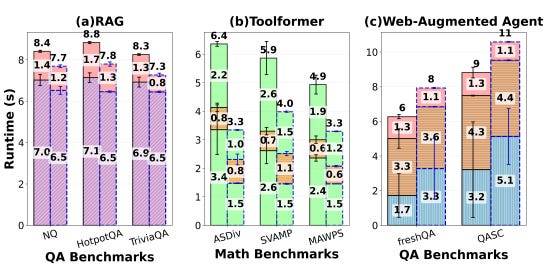
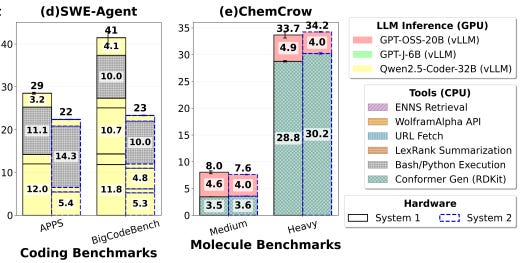
In this report, we will look at the renaissance of the host CPU. We will provide a framework for thinking about when a workload is CPU-bound vs GPU-bound that will serve as a mental model for evaluating any agentic workload. While the common narrative is that CPUs are in short supply and more of them are needed for agentic AI, the specific framing in this article is that CPUs are actually the bottleneck.
Here’s what we will cover:
The thesis (CPUs are the bottleneck, not just “in demand”)
Pure inference vs agent orchestration
The reasoning-vs-action sliding scale
9 CPU metrics defined and explained that classify CPUs for agentic workflows
A reasoning-heavy workflow example + the scoring of the metric table
An action-oriented workflow example + scoring of the metric table
The full CPU comparison table scoring 16 CPUs from NVIDIA, Intel, AMD, and others.
Key takeaways and what it means for Intel, AMD, and the ARM ecosystem
Discussion on x86/ARM structural dynamics
If you don’t have a paid subscription, you can buy individual reports available in this link.
For more a detailed look at each CPU mentioned in this post, see the follow up article with detailed explanations of rankings.

Note: This edited has been lightly edited since it’s original publish date to be more current. Last modification: April 23, 2026.
Pure Inference vs. Agent Orchestration
For the last two years, the standard LLM workflow has been a human-in-the-loop cycle: you type a request, wait for a response, read it, think about it, and then act. This loop is inherently slow because the human is the bottleneck.
In the age of agents, the human steps out of the loop and the agents themselves take over this cycle. Based on a broad human input, each agent reads a response, formulates a plan, fires off a tool call or a new inference request, and waits for results. The critical difference is that there are hundreds of subagents per user, all cycling through this loop simultaneously. The faster this loop completes, the faster the agents finish their tasks. A higher number of agents allow many parallel tasks to happen at once, whose outputs then all need to be co-ordinated. The handling and orchestration of agents all happen on the CPU.
Pure Inference
In a pure inference workflow, the user sends a request, the CPU tokenizes it (converts the text into numerical tokens the model can process), and passes it to the GPU for inference. The GPU runs the tokens through the model, generates output tokens, and hands them back. The CPU then de-tokenizes the result and delivers the response to the user. The figure below shows this workflow.
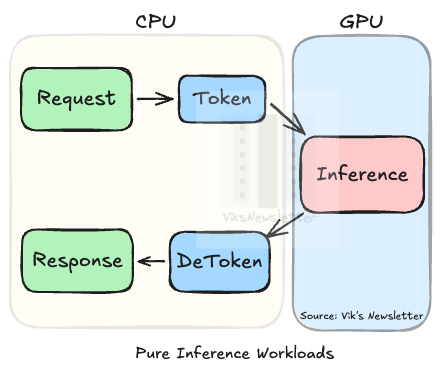
The CPU’s role as a “head node” is limited to getting the request to the GPU and getting the results back to the user. The compute-intensive work (the matrix multiplications, the attention calculations, the token generation) all happens on the GPU. This is why, for the last two years, the GPU has dominated the conversation around AI infrastructure. In a pure inference setup, the CPU is lightly loaded and rarely the bottleneck.
Agent Orchestration
In the orchestration workflow, the CPU goes from being a supporting player to becoming the command layer. CPU performance ultimately dictates how much of the GPU is utilized.
The workflow starts the same way: the user provides a request and the CPU tokenizes it. But instead of generating a response, the first inference call generates a plan of execution. That plan is then carried out by multiple sub-agents running in parallel, each calling different tools and waiting different amounts of time for completion. The CPU orchestrates the relationships between these sub-agents: which are independent, which depend on results from others, and in what order they complete. Each sub-agent may also run its own inference loop based on chain-of-thought reasoning.
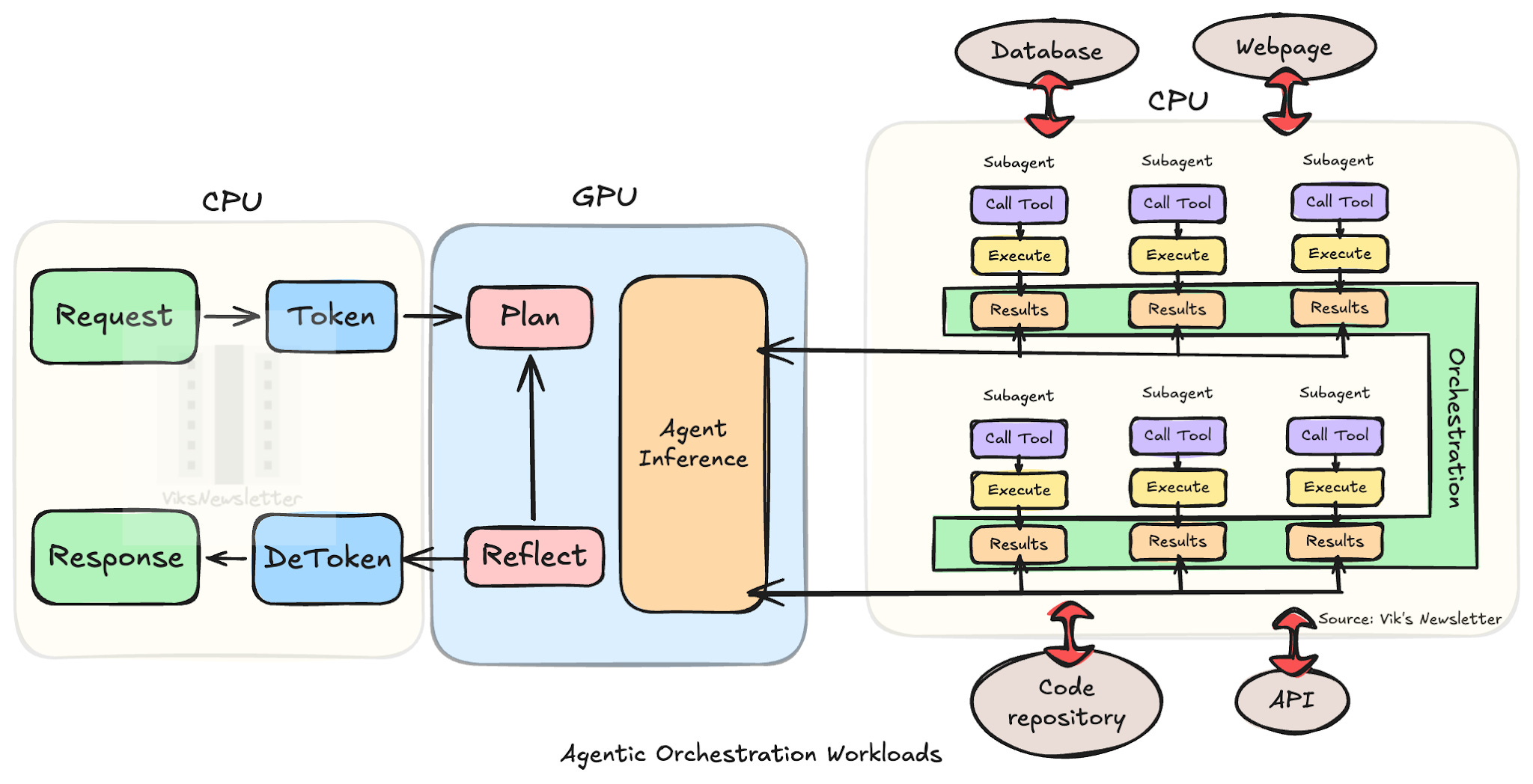
Successful agent orchestration requires three things:
A capable CPU running at high enough clock frequency to monitor every token with minimal latency and determine when a sub-agent has finished and integrate those results into other sub-agents as needed.
A high core count so that many agents can run in parallel, working on many tasks at once.
Low latency access to memory for context and intermediate state, making cache design and memory hierarchy essential.
Once all sub-agents complete, the CPU integrates their results and sends them into a reflection inference loop to evaluate whether the original request has been met. If not, another cycle of planning, inferencing, and tool execution begins. This continues until the final result is achieved, de-tokenized, and returned to the user.
Reasoning vs. Action: What Determines the CPU-to-GPU Ratio
How much CPU versus GPU is used in an orchestration workflow depends on what the workflow actually is. The framework for thinking about this is to view this on a sliding scale as shown in the figure below.
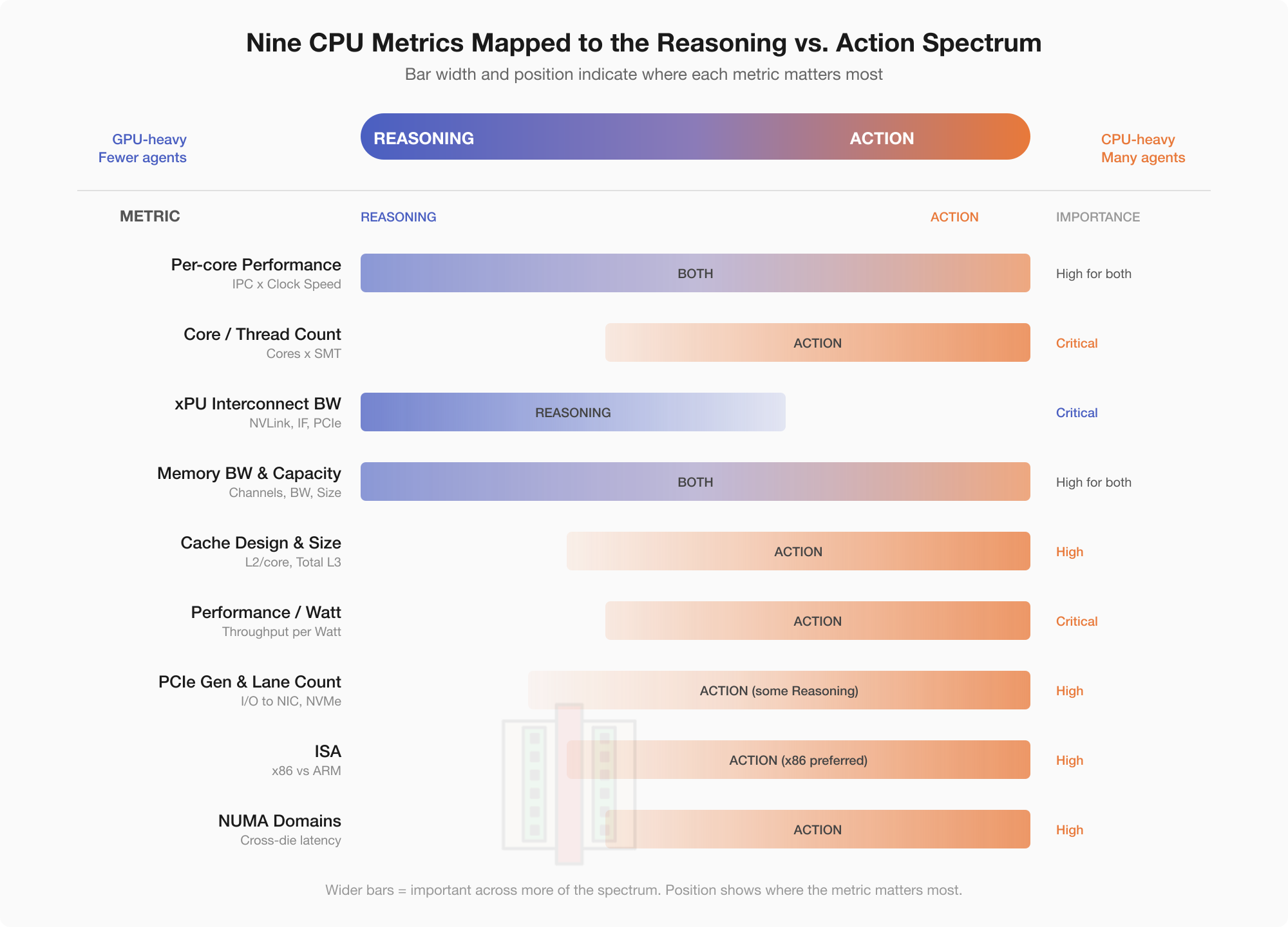
The suitability of any server CPU for the agentic workload is determined by scoring along the following nine metrics.
Per-core performance and clock speed: The CPU needs to make orchestration decisions quickly to keep the GPU fed. It also needs to constantly monitor tokens from each sub-agent to understand when it is done, and what should be done next, all with minimal tail latency.
Core count: Each core let’s say handles one agent, or context switches between a few agents to orchestrate inference loops. Features like simultaneous multi-threading (SMT) allows for more agents per core. Depending on the workload, a single agent can even use multiple cores/threads.
CPU-xPU interconnect bandwidth: Determines how fast the CPU can feed data, or read from the xPU.
CPU memory bandwidth and capacity: Higher memory bandwidth means that larger contexts, KV-cache and inference prefilling can be done with lower latencies.
Cache design and size: More L3 cache implies that memory latency is less noticeable for bursts of random data accesses because the CPU doesn’t have to go off-chip.
Performance per watt: When deploying thousands of agents, per-agent unit economics depends on how much energy it uses to get the required performance.
PCIe generation and lane count: Agents make API calls, hit storage, scrape the web. I/O connectivity to the network and NVMe storage determines tool-call throughput.
Instruction Set Architecture (ISA): x86 vs ARM matters because it dictates what support exists for tool calls. ARM’s simpler RISC ISA provides performance per watt benefits. In addition, the preference for ISA determines what ecosystem you are locked into (Grace (ARM)+GPU from NVIDIA, x86+TPU from Google, or even x86 + NVIDIA).
Non Uniform Memory Access (NUMA) Domains: Modern server CPUs are almost always composed of multiple chiplets to accommodate many cores. Depending on the interconnect technology between chiplets and physical layout, each CPU can have a non-uniform access latency to memory. This implies agents running on different cores can see different memory performance.
For the sake of simplicity here, we will restrict ourselves to cases where matrix operations are only handled by GPUs. So we will leave out features like Intel’s Advanced Matrix eXtention (AMX) where inference can occur on CPUs.
Depending on the kind of agentic workload (reasoning vs. action), certain metrics matter more than others, while others are common across all workloads. We will look at this next.
Reasoning-Oriented Workflows
Let’s use an example that is reasoning heavy, focussed on fewer agents, but each agent does extended chain-of-thought reasoning that makes it GPU heavy.
A user asks an agent to produce a comprehensive analysis of the DRAM market outlook for 2027 based on a large collection of market research reports provided. The orchestrator plans 10 sub-research areas. Each sub-agent runs a long chain-of-thought inference loop, generating hundreds or thousands of reasoning tokens as it synthesizes its area. Occasionally a sub-agent retrieves a document or does a web search, but 80%+ of the compute time is spent in inference. The agents are thinking, not doing and once all sub-agents finish, a final reflection pass synthesizes everything into the output.
The table shows the relative importance of each metric and why.
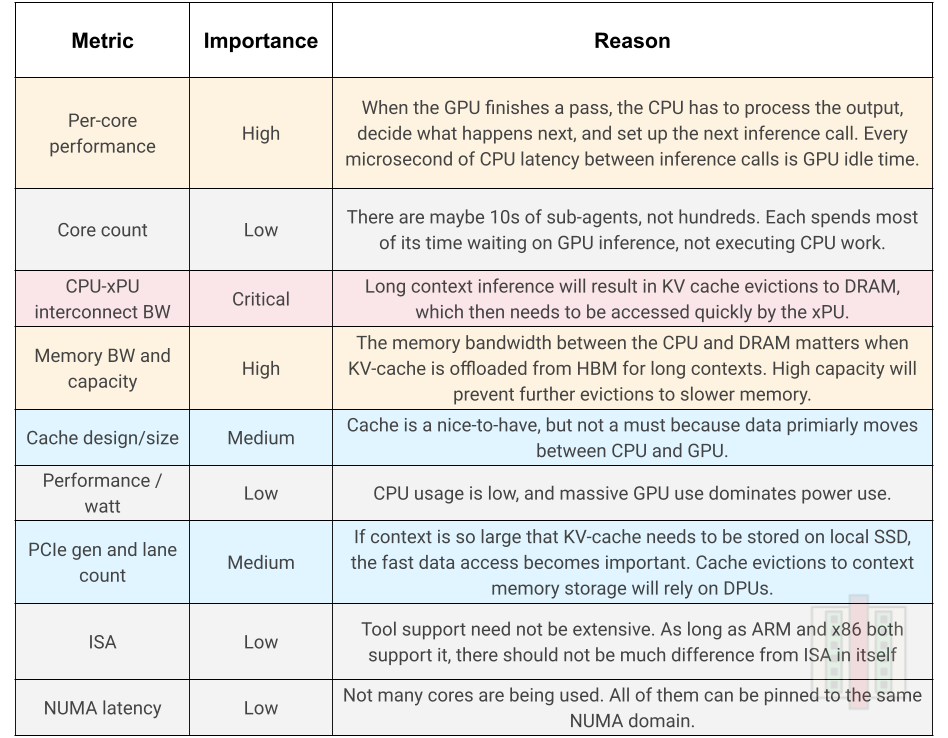
An example of a CPU well suited to heavy reasoning workload is NVIDIA’s Vera CPU for the following reasons:
Per-core performance: 88-cores of fast, custom Olympus ARM cores with multi-threading. Not the highest core count, but good per-core performance.
CPU-xPU interconnect: NVLink-C2C at 1.8 TB/s bidirectional. Coherent memory sharing lets the Rubin GPUs read directly from CPU memory as if it were their own. This is the defining feature that makes Vera a reasoning-end CPU. Nothing else comes close.
Memory bandwidth and capacity: 1.5 TB of LPDDR5 across 8 SOCAMM modules at 1.2 TB/s. Massive capacity for KV-cache expansion.
Although the choice of Vera locks you into the NVIDIA ecosystem, and the ARM architecture makes tool compatibility questionable, the massive interconnect bandwidth to GPU, fast cores, and lots of DRAM, makes it score high on every metric that matters for reasoning-heavy workloads.
Action-Oriented Workflows
On the other end, when the workflow is action-oriented, CPU utilization increases. These are tasks where sub-agents are scraping websites, updating databases, reading documents, performing calculations, or running scripts. Each of these tool calls executes on the CPU, and the time spent in GPU inference becomes a smaller fraction of the total. The more tool calls per inference request, the more CPU-bound the workflow becomes. As an example:
A company deploys an agentic system to process thousands of customer requests simultaneously. Each agent reads customer records from a database, checks order status via API, pulls shipping data from a third-party service, updates CRM entries, generates a short response, and sends an email. Each agent makes 5-10 tool calls per request with a short inference call in between for intent understanding and response generation. At peak, 500+ agents are running in parallel. The GPU handles the brief inference calls, but 70-80% of the time is spent on CPU-bound tool execution and I/O.
For such an application, the table below shows the relative importance of each CPU metric, and why.
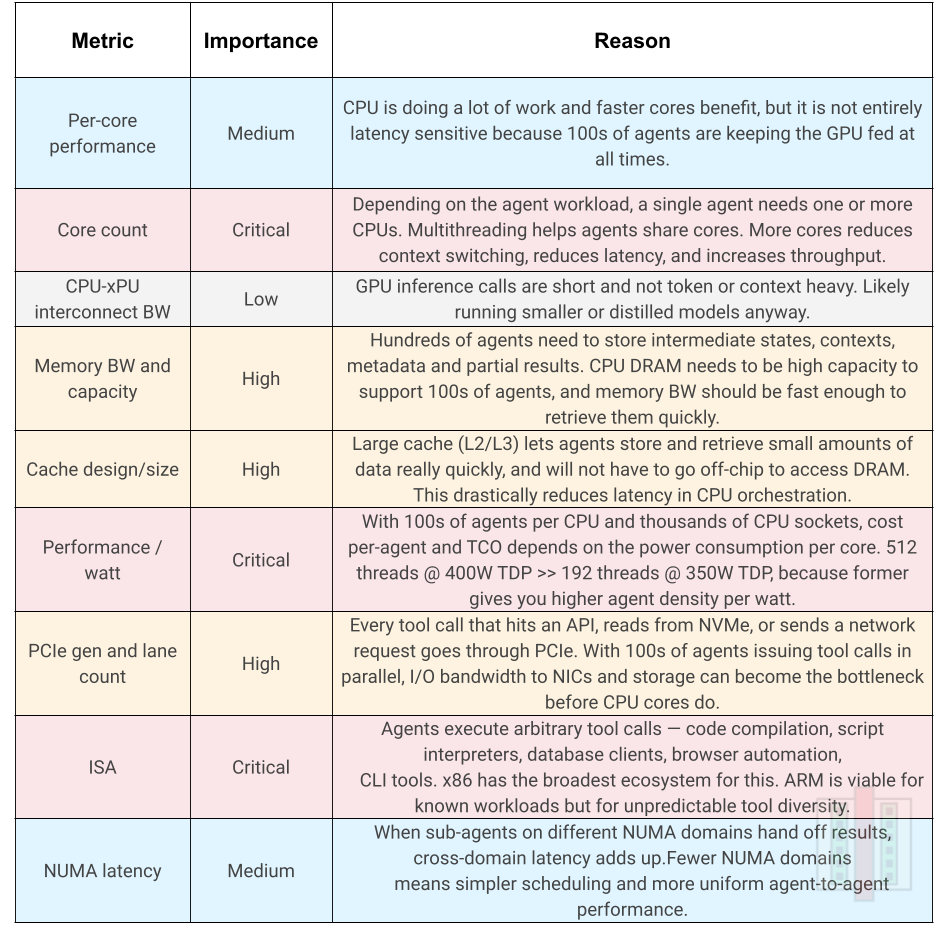
Compared to the case of reasoning heavy workloads, you can see that a lot of CPU metrics are critical for action-oriented workloads. An example of a CPU well suited to heavy action workloads is AMD’s upcoming Venice Dense CPU for the following reasons:
Per-core performance, cache: High instructions per clock (IPC) and 4MB L3 cache per core × 32 cores per CCD × 8 CCDs = 1 GB L3 cache.
Core count: 256 Zen6c cores, 512 threads with SMT. Lots of cores for lots of agents.
ISA: x86 provides broadest tool-call compatibility for diverse agent workloads.
Performance per watt: AMD EPYC series has a reputation for better power efficiency and perf-per-watt, compared to Intel.
The downside to high core counts and AMD’s multi-chiplet approach to server CPUs is that there are more NUMA domains which need to be handled. Agent scheduling thus needs to be NUMA aware.
The Server CPU Landscape: Who Wins and Where
A recent SemiAnalysis article provides a great overview of server CPUs in 2026. In this section, we apply the nine CPU metrics discussed in the previous section to all the CPUs mentioned in the SemiAnalysis article. The main purpose is to sort through CPUs available in 2026 to identify whether they are more useful for agentic reasoning, action, or both, based on the frameworks introduced in this article. Here is the summary table below.
The scoring methodology uses a numeric scale from 1-5 to indicate the desirability of the CPU feature. For example, a high core count would get a rating of 5 (Venice Dense) while low memory bandwidth would get a 1-2. In terms of ISA, x86 is weighted as more desirable (5) while ARM is rated mid-way (3) due to greater support for x86 tools (this can change in the future). To calculate the reasoning and action composite scores, the appropriate features for each end of the agentic workload spectrum is given a higher weight. For example:
For reasoning composite: The average score is computed from scores of per-core performance, xPU-CPU bandwidth and CPU memory bandwidth/capacity.
For action composite: The average score is computed from scores of core count, cache, perf/watt, PCIe speeds, ISA, and NUMA.
In either case, adjustments are made to the score on a purely judgement basis by adjusting a point up or down depending on the actual architecture and its suitability to reasoning/action and company specific choices. This part is not a purely mathematical formula, but allows for non-tangible factors to be accounted for.
Note: This table was updated on April 23, 2026 to include ARM AGI CPU, and exclude Huawei Kunpeng 950 (unsure of CPU metrics). Also, this is the last iteration of the table that will overweight x86 over ARM ISA. The gap is narrow today, and more hyperscalers are deploying both equally.
Claude Opus 4.6 Thinking was used to create the scoring tables, along with detailed explanations of scores for each CPU listed in the table. The detailed explanation for the scores of every CPU in the list, and the in-depth scoring methodology, is in a follow up article for paid subscribers.
The key takeaways from this study are as follows:
Vera and Venice Dense are at opposite ends of the spectrum. Vera scores 5 for reasoning and 2 for action. Venice Dense scores 3 for reasoning and 5 for action. The gap between them on each other’s turf is large — confirming that CPU designs are diverging along this spectrum.
SMT is a critical differentiator for action workloads. Intel Diamond Rapids’ removal of SMT (192 cores = 192 threads) makes it worse than the older Intel Granite Rapids (128 cores = 256 threads) on thread density. AMD Venice Dense’s SMT doubles its effective thread count to 512, creating a 2.7x advantage over Diamond Rapids.
The middle ground is occupied by AMD Venice-F, AWS Graviton5, and ARM Phoenix. These CPUs have meaningful capability at both ends of the spectrum — Venice-F through x86 versatility and AMD GPU attachment, Graviton5 through emerging Trainium3 head node role, and Phoenix through PCIe6 XPU attach.
Intel is compromised. Diamond Rapids scores 3/3 — mediocre at both reasoning and action. The cancellation of 8-channel Diamond Rapids-SP leaves Intel’s mainstream market stranded on Granite Rapids until at least 2028. As a result, they have neither a clear reasoning-oriented CPU, nor an action-oriented one. Intel may have a path back via Coral Rapids with SMT restored.
ARM’s SMT gap matters. Standard ARM Neoverse cores don’t support SMT, limiting all hyperscaler ARM CPUs to 1 thread per core. Only NVIDIA Vera (custom Olympus) has SMT (-ish) among ARM offerings. This gives x86 a structural advantage in thread density for action workloads.
NUMA is the universal weakness of high-core-count designs. Every CPU with 192+ cores has NUMA scores of 2-3 (except single-die designs like Vera). This is the hardest engineering problem to solve as core counts scale.
The x86 advantage when it comes to SMT support and a wider supported software ecosystem depends on the cross licensing agreement between Intel and AMD, and ARM’s emergence in datacenter CPUs might disrupt both.
Structural Dynamics between x86 and ARM ISA
It is important to understand that AMD’s x86 license only exists because of an agreement dating back to the 1980s when IBM required a second source for PC processors. Intel owns the base x86 ISA and AMD owns the 64-bit extension (AMD64). Strangely, AMD licenses the base x86 ISA from Intel and Intel licenses the 64-bit extension from AMD. Thus AMD’s dominance on Venice Dense is hinged on the ability to mutually license the x86 ISA. Anything that disrupts this licensing agreement will be a big threat to AMD’s CPU dominance.
AMD’s success with x86 isn’t Intel’s biggest problem. Intel’s worst outcome is when both AMD and Intel lose to ARM by failing to keep the x86 ecosystem dependence alive. x86 is mutually beneficial for Intel and AMD which is why they formed the x86 Ecosystem Advisory Group in 2024. Today, the x86 tool ecosystem creates a moat, but with the rise of ARM adoption in the datacenter, the complex cross-licensing agreement becomes more of a liability.
ARM ISA adoption in the datacenter is growing with AWS and Google porting workloads to support it. As the ISA gap narrows and more tools are supported, x86 vs ARM will become virtually indistinguishable from a user point of view. At this point, ARM’s inherent efficiency and lower TCO due to their simpler RISC architecture will start to shine through.
Today, the CPU world has both ARM and x86 in equal demand. The architectural differences that existed have largely melted away. The winners of the CPU race today are those who excel at execution and bring CPUs at scale to the market.
Download this report in EPUB and PDF formats below

Tables in these documents have not been updated. Substack is always the trusted source.
Very nice deep dive. A couple of high level questions: this article makes a case for how in agentic workflows CPU is limiting compared to GPU but perhaps not so in inference workflows. Q1) Seems like this 2026 GTC and the Vera Rubin architecture was all about gearing up for inference- Jensen repeated this message many times. Is the Vera Rubin architecture equally optimized for Agentic workflows? If yes, how is Vera for agentic workflows compare to Blackwell? Q2) Jensen made a good why having racks specifically for CPU, GPU, LPU, Mem etc in Vera speeds up inference. But based on this article the limitation for agentic workflow maybe CPU-GPU communicaton in which case it’s better if both are in same rack (ie Blackwell) rather than in different racks (ie Vera)?