

The most discussed topic this week by far was whether CPO is delayed (or not), and whether the adoption of 800VDC is moved out (or not), triggered by the SemiAnalysis institutional note title “Powered Down, Lights Off.”
It is arguably a provocative title, but going purely off the heading is akin to judging the book by its cover. The institutional note “automagically” landed in my inbox and I had a long, quiet read to process it. I also read all the notes by FundaAI around this, a few other Substack notes, and tried to keep up with the flurry of takes on X.
The now infamous note is largely post-Computex, where we identified optics and power as the major themes as well. Here is our coverage this week:
The long and short of it that CPO is coming eventually, as is 800V; nobody denies this, but the controversy is around the when. We’ll focus on CPO today.
The SemiAnalysis claim worth focusing on is that Spectrum-6 CPO is slipping by 2+ quarters due to: (1) an unusual level (>3.5 dB) of optical loss in Spectrum-6 that eats link margin and notably higher than Spectrum-5 that uses a similar port count forcing a redesign, and (2) a yield constraint that causes issues at scale.
We have no way of verifying actual numbers here, unless the reader is the rare case of the one actually working on it. However, technical discussions around these two claims are light, and rebuttals mostly come from the supply chain argument side. There is little dialogue around understanding why this could happen, and if the engineering side holds up.
We will try to fill in this gap today.
This edition of TWiC is presented by … SambaNova
Run frontier models. Skip the GPU rack.
SambaCloud runs MiniMax M2.7, the fastest provider for this model, at 435 tokens per second via API. M2.7 ranks alongside Claude Opus 4.6 and GPT-5.4 on agentic and software engineering tasks, at a fraction of the cost. No hardware procurement, no lead time, no sharding across hundreds of GPUs.
Texas Advanced Computing Center, OVH Cloud, and Hume.ai are already on the platform. If you’re running long-horizon agent workflows in production, M2.7 is available today on SambaCloud’s Developer and Enterprise tiers. Benchmark your workload against your current provider in an afternoon.

The industry agrees as a whole that scale-out is where CPO lands first. NVIDIA Spectrum-X CPO (Ethernet) and Quantum-X CPO (Infiniband) are slated to enter mass production in 2026. The SemiAnalysis claim is that the Ethernet version is due to slip by 2+ quarters, and is materially important because the Ethernet version ships more volume than the Infiniband one.
Both the increased optical loss and yield issues have their roots in the sub-micron accuracy alignment requirements of optical engines for CPO, and requires a procedure called “active alignment.” It involves optimizing the fiber attach unit (FAU) to the photonic chip across 6 degrees of freedom (position+angle across x,y,z). The alignment is done by actively monitoring the amount of optical power being coupled, and a few degrees of freedom are adjusted till maximum power is coupled.
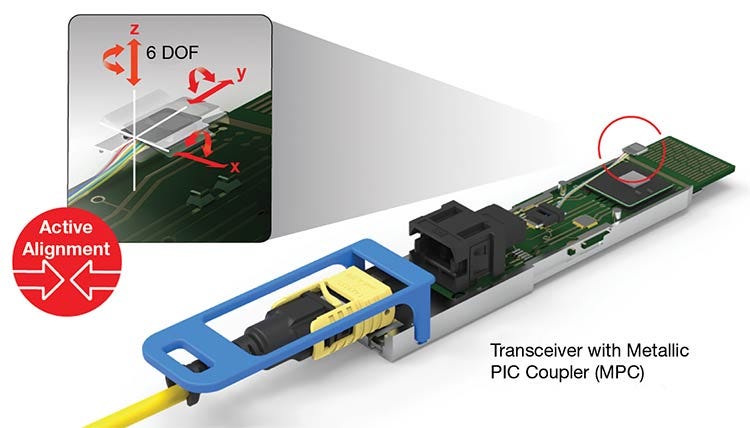
This has to be repeated for each optical engine in the whole Spectrum-X switch, and is required at several points along the CPO build process. Even a single CPO module can require 100+ active alignment operations from start to finish, each one taking only a few seconds from start to finish in high volume production.
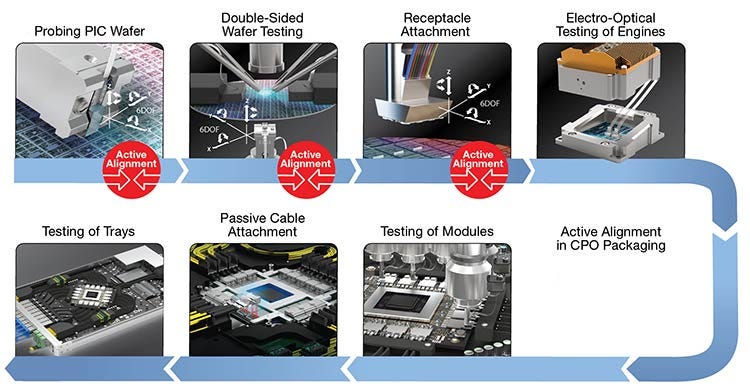
CPO testing is an interesting aspect that deserves its own deep-dive, but key takeaway is that co-packaging an optical engine next to the silicon is notoriously difficult, and the difficulty arises when all of them need to work when attached. Quantum X actually implements CPO differently from Spectrum X as shown in the pictures below.
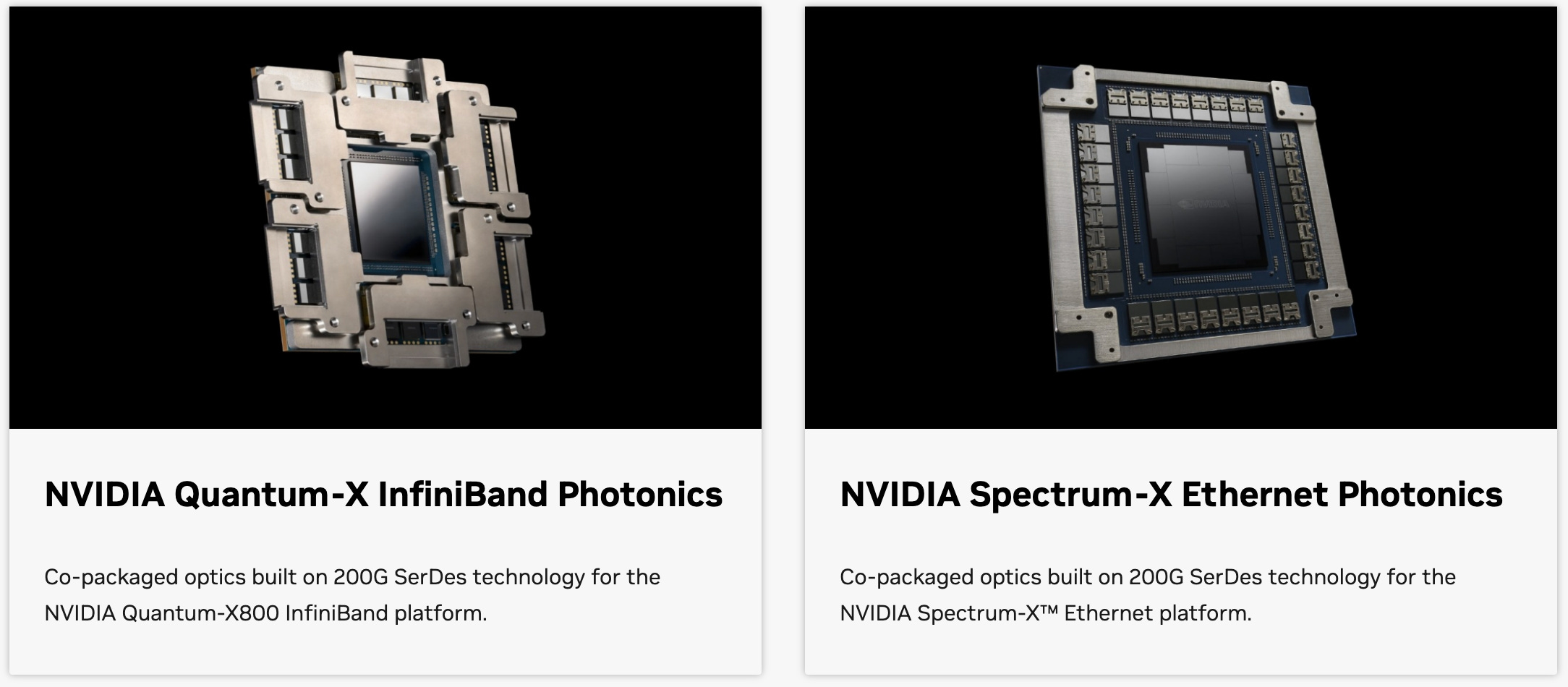
Quantum-X is designed for routing supercomputing traffic with ultra-low latency. It has a total of 18 optical engines (6x optical subassembly with 3 engines each) to provide 18 ports in an NVswitch supporting Infiniband. Quantum X uses a replaceable module of 3 optical engines that can be swapped out as a whole if any one of the three engines in the module do not work. The complexity of active alignment is limited to just the optical subassembly now. If the yield of each attachment is 95%, the overall yield of the subassembly is 0.953 = 0.853, or 85.3%.
Spectrum-X handles larger, multi-tenant cloud and Ethernet AI environments and thus requires more port counts, and more optical engines per switch. As a result, the “swappable module” approach does not work for this product line due to sheer lack of space. You can see from the picture that there are 32 optical engines directly co-packaged next to the silicon. A single non-functioning optical engine poses a danger to the entire switch.
Here the math is that if each one has a 95% chance of success, then the chance of all 32 engines being successful is (0.9532=0.193, or ~19%). This makes it significantly harder to deploy Spectrum-X switches at scale if the yield is so low. If you want ~85% yield like we saw in the 3-engine optical subassembly, the required attachment yield rate skyrockets to 99.5%. There are some counter-arguments floating by to this method.
Is the yield really 95%? This number is genuinely difficult to come by, and if based purely on hearsay, is something to take with a grain of salt. The exact yield number matters a lot, arguably to the last decimal point, when you take a power of 32. Hand wavy napkin math does not work here.
Failing parts are binned. One post I read argues that the napkin math is bad because optical engines are binned and only functional ones will be attached and therefore the failure rate cannot possibly be that high. Yes, failing parts are binned, but the actual failures come during/after the attach process. As a result, there is no way to avoid the power of 32.
Most of the commentary on this matter has been a rebuttal on the basis that the bottleneck is on the supply-side, and not the demand side. Lumentum’s comments at the Mizuho conference also stated how much demand is waiting for them, if they could only ship. Morgan Stanley released a note with wafer shipments, while acknowledging TSMC yield numbers in SoIC and downstream assembly yield.
The loss and yield argument makes “qualitative” engineering sense given how Spectrum-X and Quantum-X CPO architectures work, and the crux of the SemiAnalysis argument reduces to finding the right yield number. If there is a fundamental problem with the active alignment process, it is easy to drop half the optical power (which is what 3 dB of loss is) due to misalignment issues; remember that the alignment accuracy requirements are sub-micron for thousands of optical fibers per switch. The loss number itself is within the realm of reason given how sensitive CPO is to alignment issues.
Given how new the industry is to CPO at scale, loss low yield could very well be growing pains as the technology ramps. It is not an unsolvable problem; just one that takes its time as assembly processes for CPO mature. It is entirely reasonable that the alternative while the industry grows to adopt CPO, is NPO.
In the case of NPO, the assembly and packaging process is much simpler because only the optical engine in that NPO module needs active alignment — it is not an exponent-stacking problem like in CPO. This makes it much more conducive to the short/medium term while the CPO production process matures.
What the Street missed in the whole controversy is that whether it is NPO or CPO, the optical content remains unchanged. It is only a question of how the packaging works and the demand for optics is higher than ever, just in different form factors.
The controversy that matters operationally is serviceability. A pluggable optic is field-replaceable; once you co-package, a single laser failure can strand a switch port, which is why external laser sources and photonic known-good-die testing become the real gating supply chain. Lasers also dislike sitting next to a hot switch ASIC, so the thermal budget, not the optics, sets the integration limit.