

I recently posted in the Semi-Doped Daily newsletter about Gavin Baker’s recent podcast on Invest Like The Best with Patrick O’Shaughnessy. The 80-minute interview was packed with insights, and it has given me a lot to think about this week. If you have not watched it yet, here is the YouTube video.
Thoughts swimming in my head this week have been entirely around the reality of “Orbital Compute” that Gavin mentioned on the podcast as the next big thing. I just wanted to pen down major themes swirling around this topic, on this week’s TWiC, so that I can revisit this when it becomes The Big Bottleneck™, but hopefully sooner than that.
In other news, I have content published around inference accelerators this week.
Ok, lets get to the space stuff.
There has been a lot going on around the idea of putting datacenters in space. Some newsworthy items in no particular chronological order.
Startcloud put an Nvidia H100 in space — they have a nice whitepaper worth reading.
Elon Musk explains on X how datacenters should ideally go to space.
Google’s moonshot Project Suncatcher explores putting Google TPUs in space.
Axiom Space is a company working on orbital datacenters.
Last week, Google and SpaceX are in talks to launch datacenters into orbit.
There’s probably a lot more (leave it in the comments), but 5 bullets will do for now.
With the impeding SpaceX IPO, and the fact that SpaceX has an absolute stronghold in the reusable rocket market while also running datacenters here on Earth, the interest in orbital compute is on the rise. In the interview, Gavin thinks orbital compute is just around the corner — in the 2027/28 timeframe.
The one thing Gavin clears up immediately is — “don’t think about it as a Pentagon-shaped datacenter in orbit.” Instead, he asks you to think about racks in space, not entire data centers floating in sun-synchronous orbit.
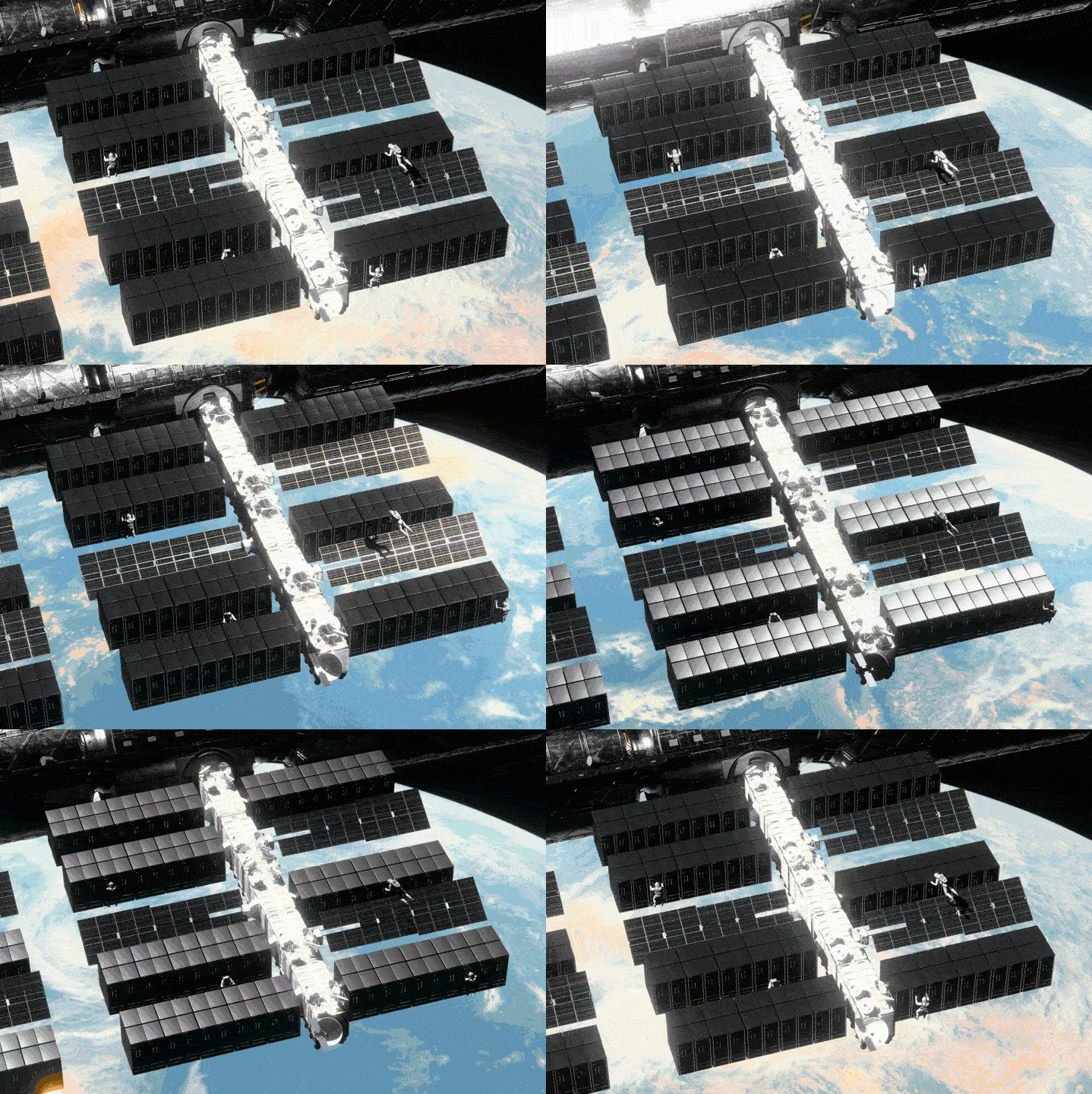
Today, the power onboard satellites is around 20 kW, and SpaceX engineers seem to think they can scale that up to 100 kW, which should fit a Blackwell-class rack in orbit. The networking aspect is most interesting. Scale up would remain in copper within the rack for sure, but scale out would use free space optics to connect between orbital racks. Most amazingly, SpaceX satellites today already have the ability to communicate with each other to operate in a mesh using free space optics. This technology isn’t in a lab; it’s actually up in space today.
For the industry itself, running data centers in space means that there are four markets that open up to make this happen.
1) High power free space optics
Connecting racks with free-space lasers isn’t something we do on earth today but constellation operators already have optical satellite links built into them, including SpaceX and Amazon, with Telesat and OneWeb still considering adding laser comms to their satellites. The use of free-space optics would open up an entire segment of the optics industry that isn’t directly involved with AI data centers today such as Tesat (privately held) who are widely known for inter-satellite optical communications, CACI (CACI 0.00%↑) for their optical terminals for defense work, General Atomics, and others such as Skyloom (bought by IonQ) and Bridgecomm (acquired by Voyager Technologies). If optical comms in space are going to become a thing, only a few people really know how thats done today.

Imagine, if NASA’s Terabyte Infrared Delivery Subsystem (TBIRD) could run at 200 Gbps from Earth to orbit in a system the size of a tissue box, we can connect racks in space alright. I’ve written about this before; see post below.

2) RF SATCOM Companies
If you want to communicate with data centers in space from Earth at scale, the best-known approach is through satellite communication systems operating at Ku or Ka band. Starlink terminals currently use this frequency range and typically require their own satellite terminal to communicate with satellites at sufficient bandwidth.
Companies have tried going direct to cellular, but the bandwidth is usually not high enough. The idea of data centers in space could give second wind to companies working on RF-based SATCOM, especially since their forays into millimeter-wave 5G failed spectacularly.
The key technology here is mmW phased arrays, which use an array of antennas that can be cleverly controlled to form a pencil beam aimed directly at the satellite for maximum data throughput. There’s a GaN angle here too in power amplifiers for satellites. Qorvo, MACOM, Analog Devices are among some companies with this expertise.
Since I have actually worked in this field, I’ve written a bunch of posts about this, if you’re interested.


3) Radhard Specialists
If you’re not familiar with silicon in space, you need to know that silicon has to be space qualified and radiation hardened (Radhard) to work in space. Low Earth orbit deployments are easier from a radiation-hardening perspective because the Earth’s atmosphere shields a lot of radiation. As you move farther from Earth, radiation requirements get much worse.
Aside: I attended a talk by the Voyager mission’s chief engineer at IMS 2025, and he explained how insane it was to design electronics that work in the radiation environment of Jupiter. He was cracked AF and a great storyteller! At 15 billion miles away, the data rate from the Voyager is 160 bytes-per-sec. 😭 A 1-way message takes a day!
The ability to test and qualify parts for space is something a company builds over time, and it typically requires a unique end market. Not every silicon supplier can serve these markets, but defense providers and companies in the satellite space often have this capability, so it is worth watching for. Also, it would be wrong to assume it’s only the GPUs that need space qualification. Every component, from memory up through lasers, PCBs, connectors, and cabling, needs to be qualified for space operation. It’s a different ball game the industry is not entirely ready to play at the scale of orbital datacenters today.
4) Cooling Technology
A common mistake is assuming data centers are naturally suited to space because it’s so cold. Convection is the best way to extract heat from surfaces via air- or liquid cooling, and space naturally has neither.
The only way to remove heat from chips in space is through radiation, which is much less efficient. Cooling is a hard problem for data centers in space, even if liquid cooling is used because heat still has to be radiated away with large radiators to keep the chips cool. The ISS rejects on the order of 70 kW with very large panels, so cooling a single rack in space seems feasible in theory.
The best part is that space, well has “space”. You can make the radiators hundreds of feet in size, so a lot of heat can be exchanged with the cold sink outside kept at a steady 2.7K. NASA studies show radiators can account for more than 40% of total power system mass at high power levels. That is the real reason this is hard.
Some companies to watch for in this space are Sierra Space, Paragon Space Development, Redwire Space, ThermAvant Technologies, and Advanced Cooling Technologies.
If AI is going to space, then I’m going to write deep dives about its various aspects.
Meanwhile, have a good weekend!
Appreciate all the interesting tidbits! Here's a more skeptical take on the idea from a physics prof, especially on the cooling side: https://nanoscale.blogspot.com/2026/02/data-centers-in-space-make-no-sense-to.html
Great read Vik!