

There has been considerable chatter about Lumentum’s lasers and their narrow linewidth, contrasted with questions about the viability of microLEDs in datacenters. I’ve been meaning to write about microLEDs for quite a while; we’ll cover some general aspects here. Since MicroLEDs are a big topic, this is best handled as a sequence of posts that build up the whole picture over time. We will make constant comparisons to lasers since it is the incumbent optical technology. Feel free to ask follow up questions in the comments at any time - it will help guide future posts.
A useful starting point to understand the lasers versus LEDs debate is to ask what linewidth is, why it matters, and how lasers and LEDs broadly compare. Let’s first describe the technology landscape.
You can download this post in epub or pdf formats for free using the button below. If you are not a paid subscriber, and would like to purchase individual articles, please see the catalog here.
Lumentum, Coherent, and DFB Lasers
Distributed Feedback (DFB) lasers often made from Indium Phosphide (InP) are known for their narrow linewidth, where Lumentum holds dominance in 200G/lane electro-absorption modulated lasers (EMLs). Their moat comes both from having a great laser source and a co-optimized modulator that encodes high-speed electrical signals into light. The performance gap in EMLs is seemingly wide enough (specs not published widely) that their competitor, Coherent, actually buys these EMLs from them. This puts Lumentum in the driver’s seat for EMLs in the 1.6T optical era involving pluggable transceivers.

A DFB laser for co-packaged optics (CPO) is a different beast and is a space where Lumentum has serious competition. CPO requires a constant source of light (called continuous-wave or CW) because the modulation is handled by the silicon photonics chip using a ring or Mach-Zehnder modulator. Here, a constant output power of 300-400mW at elevated temperatures of 50-70°C is the key differentiator. This level of output power is needed because the light source is outside the rack, and connected to the SiPho chip via a long polarization maintaining optical fiber. We’ve discussed this earlier.

Laser Linewidth, RIN, and Power
Lumentum’s ELS laser for CPO has an advertised output power of 350 mW at 50°C, a line width of <500 kHz, for a 1311 nm laser. Coherent’s equivalent laser has a reported output power of 400mW at 50°C and a linewidth of <200 kHz. Linewidth is a measure of how pure the light source is, and is quantified by the Full-Width at Half-Maximum (FWHM). Take the maximum laser power, cut it by half and measure the spreading of the laser frequency/wavelength. The smaller this number, the more pure the laser output on the spectrum.
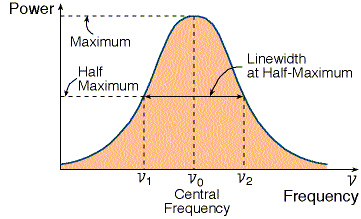
Anything under 1 MHz in linewidth is exceptionally pure light, really. A 1311nm laser translates to about 230 THz in free space which is really narrow compared to the center frequency. The deviation in wavelength is so small that laser engineers prefer frequency units to represent this. This is the magic of DFB lasers.
Lasers from both companies have a Relative Intensity Noise (RIN) of -145 dB or thereabouts. RIN is a measure of how stable the output power is. Think of a bad laser with high RIN as flickering too much. Lumentum is not much better in RIN; the frequently cited -156 dB RIN for Lumentum is a hero number from a CLEO 2022 paper. Their production RIN is in the same ballpark as Coherent. Thus, while Lumentum has a clear advantage in EMLs for pluggables, the race to CPO lasers is highly contested (there are other players but their laser specs are not publicized).
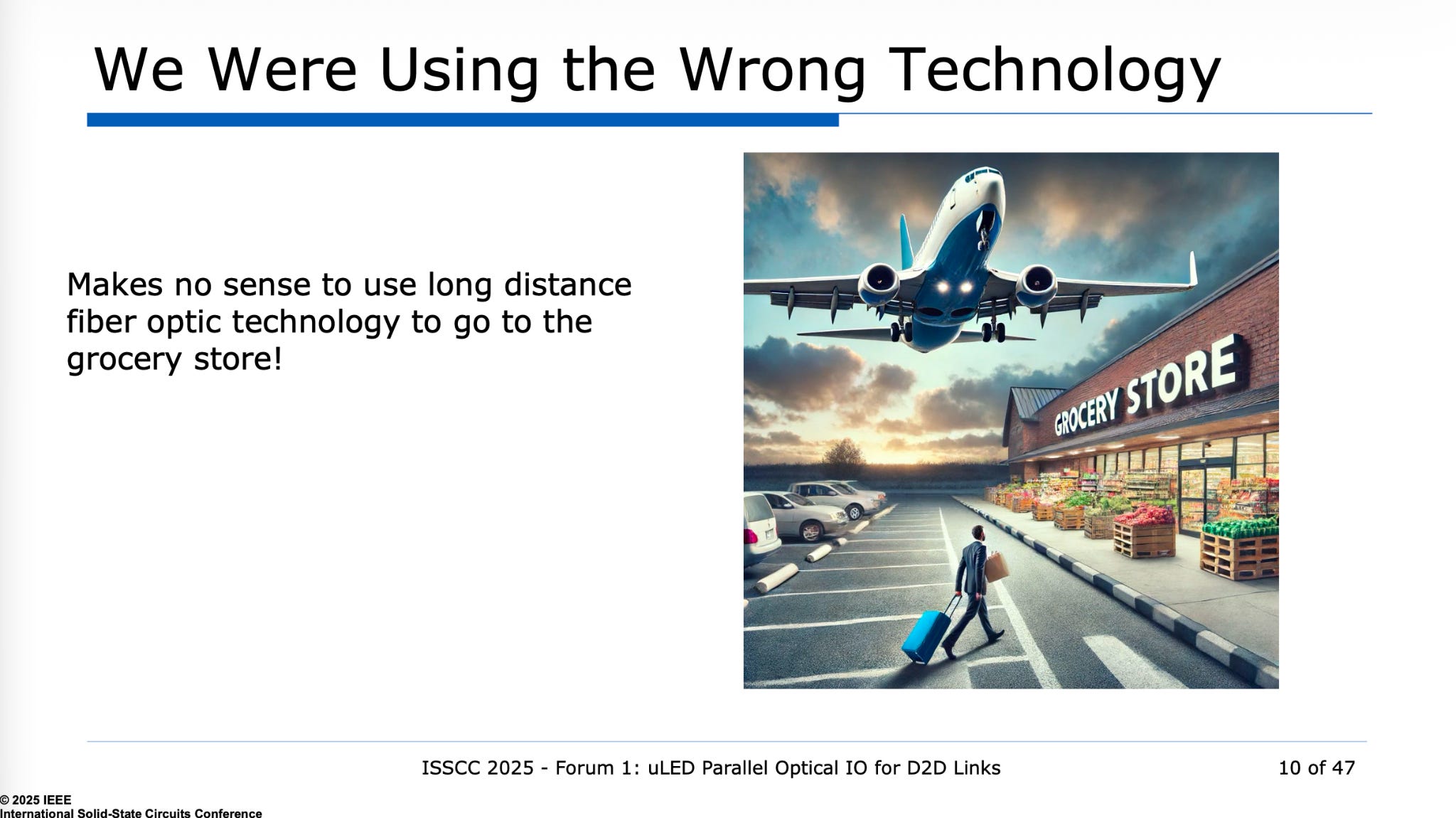
Regardless of lasers for pluggables or CPO, the key takeaway is that DFB lasers with their narrow linewidth are perfectly suited for optical communication, and have been the mainstay for long haul links. They allow encoding of fast data signals and have long distance reach. Here is the critical question: is DFB laser the right choice of technology for short-to-medium distance optical links in a datacenter?
The Case for MicroLEDs: Benefits and Challenges
There has been a slew of activity around the use of Micro Light Emitting Diodes (LEDs) for data transmission. Credo moved to acquire Hyperlume last year, Microsoft published results from Mosaic, and Marvell most recently is collaborating with Mojo Vision on microLEDs. We would be remiss if we did not mention Avicena, who has been pioneering MicroLEDs for AI interconnects for a long time.
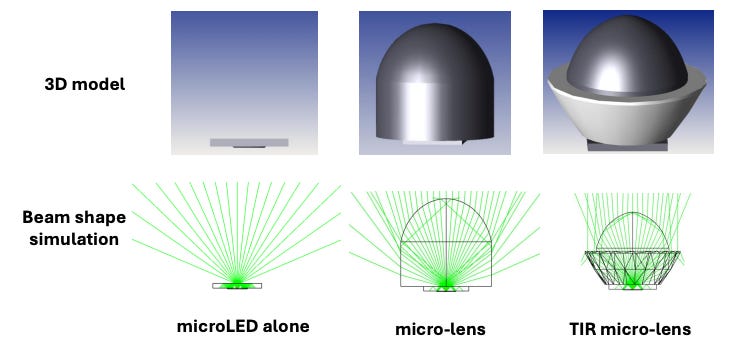
MicroLEDs are just really small versions (10-50 microns in size) of your regular lightbulbs, and are built with Gallium Nitride (GaN) to emit blue light. Just like you don’t get a laser light show every time you walk in your room and turn the light on, microLEDs do not emit a narrow pencil beam of light like lasers. They instead produce light in a wide angle and need to be focused with a microlens. The light is not spectrally pure like lasers either. Blue GaN microLEDs have a wavelength of about 450nm, and linewidths of 10-15nm. Compared to lasers, this is terrible linewidth because it accounts for about 3% around the center wavelength.
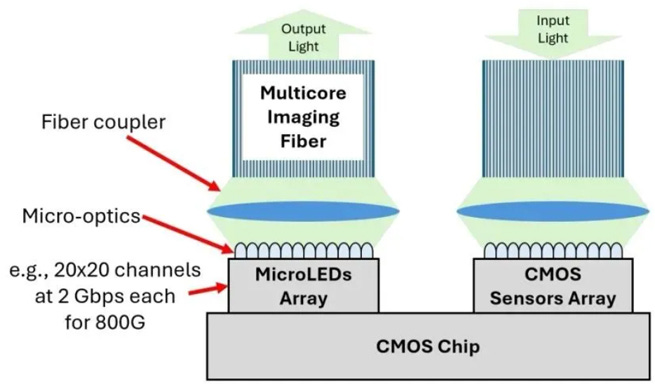
The poor linewidth in comparison to lasers imposes restrictions on data rate that a microLED optical link can support. The solution around this is to use an array of microLEDs in a “wide-but-slow” approach – just like each data lane in high bandwidth memory (HBM) is slower than what is possible in GDDR, but the overall throughput is higher. There are a few additional benefits of using microLEDs:
Lower power than DFB laser optics (caveat to follow), but better reach than copper (can possibly do >10m at Tbps aggregate speeds)
Better reliability than lasers because LEDs are structurally simpler, and relatively temperature insensitive. A wide-but-slow approach means that there could be redundant lanes for failover.
Linear path to scaling to higher speeds: increase per-lane speed (harder) or increase number of lanes (easier).
While microLED cables would work directly with existing pluggable infrastructure, there are two important requirements that makes things more complex:
Focusing optics
The broad angle emission from a microLED needs to be focussed with microlenses in order to couple them into an array of optical fibers that carry multiple parallel lanes of data. In reality, this is not difficult because microlenses are also implemented as an array that fits directly over the microLED array. DFB laser sources have specialized optics to couple light into fibers too.
Electrical Gearboxing
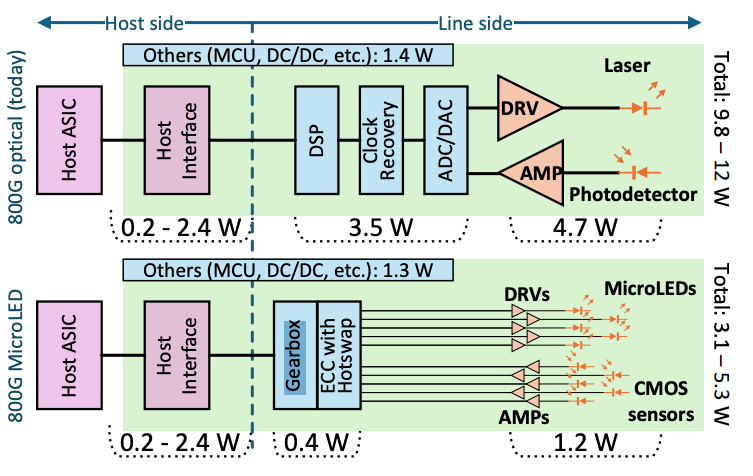
You need an “electrical gearboxing” function that converts the 112G/224G narrow-but-fast SerDes lanes of the host processor into a 20 x 20 microLED array that carries slow-but-wide signals at lower data rates. This chip is implemented as a CMOS ASIC that handles the electrical gearboxing. For example, the Avicena LightBundle™ evaluation kit launched at OFC 2026 uses a specialized 16nm finFET CMOS ASIC. The only way a gearbox chip can be avoided is to design the host processor with a UCIe interface that natively implements a wide-but-slow approach (like a custom base-die used in HBM).
Microsoft’s paper on microLEDs shows that the gearbox functionality only consumes a small portion of the power (0.4W) it would otherwise take with an optical connection that requires DSP/CDR/FEC (3.5W). The argument in the paper is that it is a simple gearboxing function, and thus less power hungry. If per-lane speeds increase in future generations of microLED interconnect, then CDR/FEC functions will be required and power usage will increase, closing the power efficiency gap between lasers and microLEDs.
Why linewidth matters for data rates
Let’s address why microLEDs are only capable of 2-4 Gbps data rates today in pre-production, while DFB EMLs can support 200 Gbps or more.
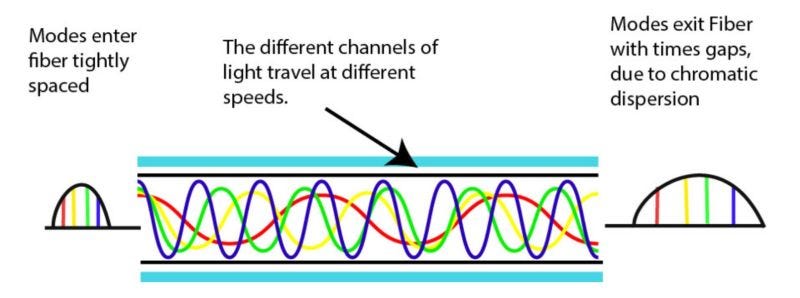
The fundamental concept that underlies this limitation is chromatic dispersion in an optical fiber. When an optic signal travels through a fiber, different wavelengths travel at different speeds due to the wavelength-dependent refractive index of glass in the fiber. The resulting pulse exiting the fiber spreads out in time because different wavelengths arrive at different times.
This spreading determines the maximum speed of data transmission that is possible because once neighboring pulses start to overlap, it is hard to tell them apart and detection errors start to occur.
The broadening of a pulse by a time dT (ps) in an optical fiber can be calculated as
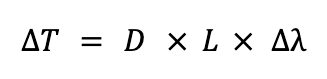
Where D is the dispersion coefficient in ps/(nm·km), L is the link length in kilometers, and is the linewidth of the light source. Assuming Gaussian pulses are being transmitted as bits, the data rate Bmax is:
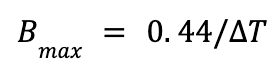
Let’s try out some numbers here.
With a microLED
A standard legacy multimode optical fiber (such as OM3 or OM4) operating at 850 nm exhibits a material dispersion parameter of approximately 100 ps/nm/km.n For an 850 nm microLED with a spectral linewidth of 40 nm (4.7% of center wavelength), operating over a link length of 0.010 km (10 meters), the temporal pulse spread is calculated as: 100×0.01×40, or 40ps. Maximum data rate supported = 0.44/40ps = 11 Gbps/lane. These speeds have been demonstrated in research papers with microLEDs, but production numbers are slower at 2-4 Gbps/lane.
With a DFB laser
Let us assume the same wavelength, and same link distance, but a linewidth of 0.001nm. The temporal pulse spread is: 100×0.01×0.001 = 0.001ps. Maximum data rate supported = 0.44/0.001 = 440 Gbps/lane.
This demonstrates why linewidth makes a big difference in how much data rate is possible with a given type of light source in an optical communication system.
There is a lot more to discuss about microLEDs before we can declare microLEDs fit/unfit for datacenter needs: coupling efficiency into fibers, beam shapes, reliability assessments, and the overall supplier/customer landscape that is still rapidly evolving.
Industry sources tell me that hyperscalers are open to exploring microLEDs for future interconnect needs, but the microLED industry for datacenter interconnects is still young. An additional aspect worth exploring is how VCSELs compare as an alternative to microLEDs – something that Lumentum is actively exploring with 1060nm VCSELs. So many future post options!
Hollow core fiber has orders of magnitude less dispersion. How fast can microLEDs switch if dispersion is not the limit? Similar question applies to VCSELs, which have wider band than DFB lasers but much better than LED. Is there a potential for hollow fiber to rewrite the rules in a data center? The direct modulation of LED and VCSEL makes them very efficient, and hollow fiber is now made in 30km lengths so manufacturing volume may be ready to scale to meet data center scenarios.
I am curious how quickly those per lane speeds can realistically improve without eroding the power advantage. How do you see thermal effects influencing linewidth stability in real datacenter conditions, especially for microLED arrays operating at scale, and does that shift the balance when comparing them to DFB lasers over sustained workloads?