

I am writing this update from Brighton, UK, this week and the weather has been downright amazing. Semis this week were even more so: AMD’s announcement of MEXT acquisition is bullish NAND, 200G VCSELs for scale up is making an appearance, and Intel is having a good week.
Other stuff in our universe has been centered around advanced packaging, in case you missed it.

As part of Semi Doped we also publish a daily newsletter with the hottest takes, straight from the oven — all for free. Sign up at semidoped.com.
Now, on to the this week’s explorations on TWiC.
How MEXT Makes Flash Work Like DRAM
This week AMD announced that they are acquiring mext.ai. The chart below is unrelated to the announcement, but also highly relevant. I’ll explain why.


This memory share estimate of CapEx is 36% two months ago, for 2027. Memory prices keep increasing, so let’s just round off to 40% for simplicity and assuming a $1T AI CapEx spend in 2027 because it makes math easy. That’s $400B dollars spent in just paying for memory. We had a whole episode on Semi Doped explaining why this crazy pricing is not useful to anybody. That much money can be spent on something much more useful — like trying to improve communication bottlenecks, or building better power delivery systems.
Any CFO worth their salt will try to reduce this spend by asking “Do you really use all that memory we pay for?” MEXT’s solution what is meant to answer this question.
MEXT is a software company that helps you deal with storage more effectively, whether it is DRAM or NAND. Their key insight is this: not everything is DRAM is immediately useful — some stuff is hot, some stuff goes cold. Then the sensible thing to do is to boot the cold data from DRAM to NAND flash which has much more storage capacity. Next, they predict using “AI” (it’s like AI ouroboros here) what needs to be in DRAM, and do the reverse as well — load data from NAND to DRAM before the compute asks for it. It’s the memory management method that sweeps data under the rug, and pulls out only what is needed at the right time.
NAND is much slower than DRAM, but when used together in a form of deliberate data dance, it becomes very effective. These kinds of storage optimizations are essentially bullish for NAND. This bottom line is: (a) Hardware builders cannot go on indefinitely adding DRAM without asking if we are using it effectively, (b) Memory companies cannot raise prices indefinitely without the industry trying to find ways around it, and (c) We will see the emergence of a lot more of software level optimizations like this in the future that will help with memory management in a clever manner.
PicoJool and VCSELs for AI Scale Up
This week a startup called PicoJool announced that they are introducing 200G VCSEL lasers for AI scale up. VCSELs have been famously difficult to make work beyond 100G due to modulation bandwidth limitations in the electrical-optical conversion. In simple terms, a high bandwidth means that the optical signal changes fast enough to track the changes in electrical signals.
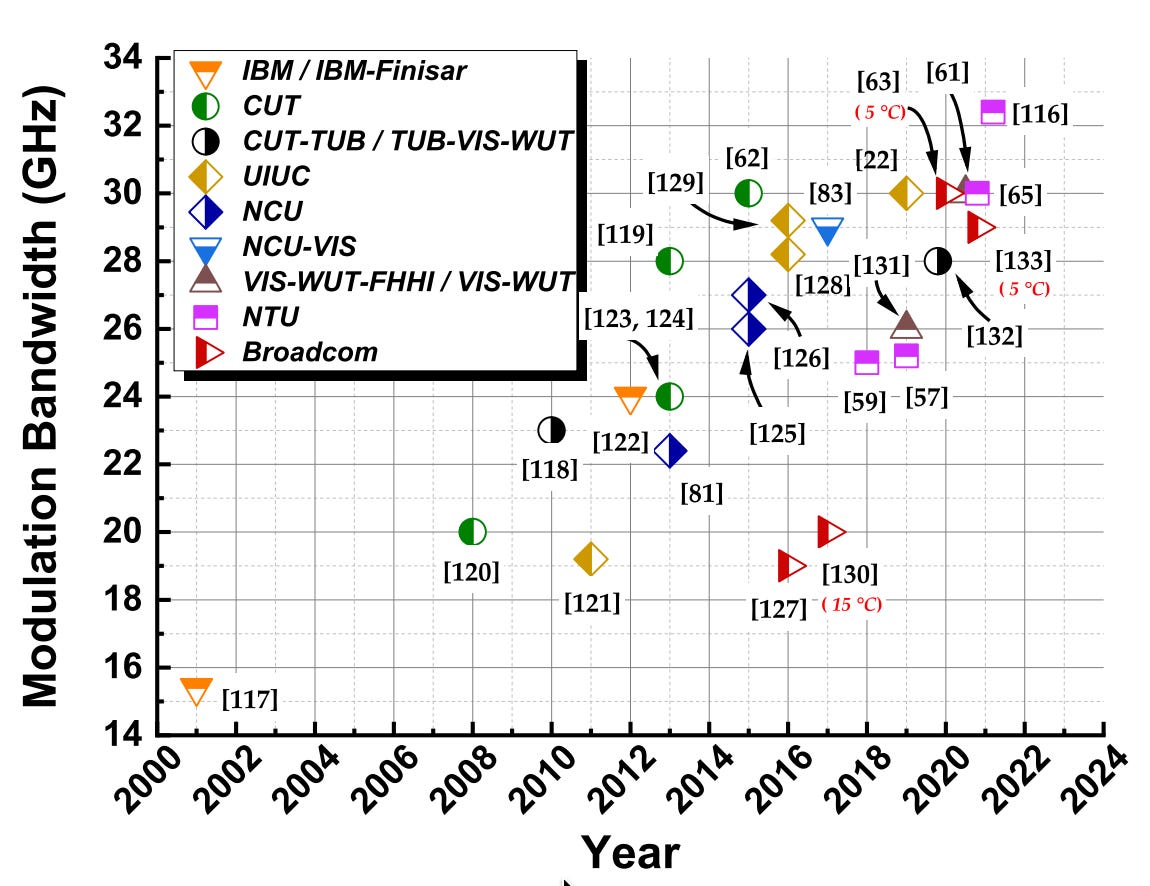
The chart above is from a 2022 paper showing the modulation bandwidths of 850nm VCSELs. As you can see, VCSELs have been continuously getting faster, and capable of supporting higher modulation bandwidths. PicoJool’s stated bandwidth is better than anything on this chart — at nearly ~38 GHz. Their measurement is shown below.
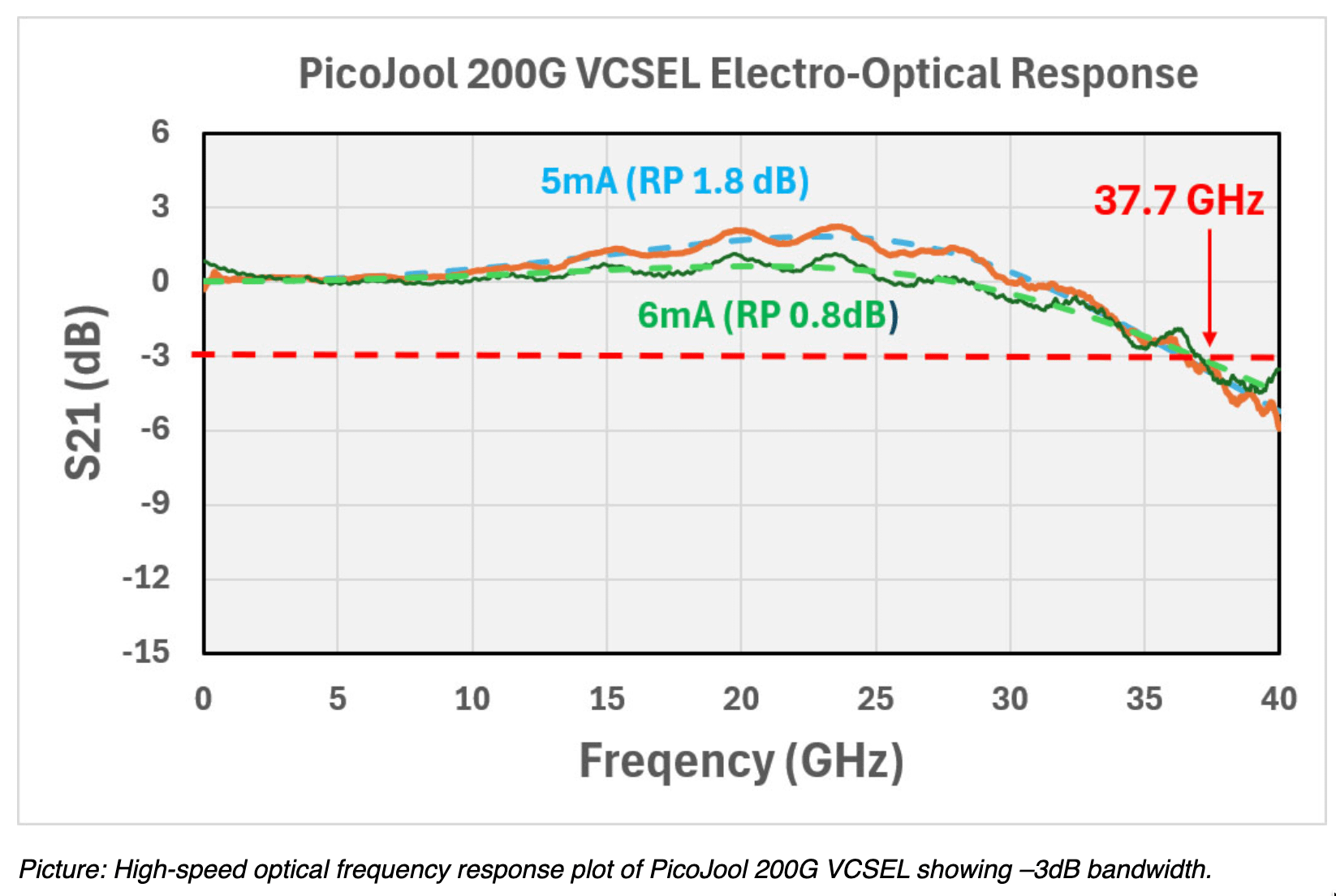
The way to read this is to think of a continuously varying RF signal being input to the electrical-control of the VCSEL. At say 10 GHz, there is little loss from the conversion to optical — ie, the S21 (transmission scattering parameter) is 0 dB. That means just rapidly changing the electrical input doesn’t make the VCSEL light any dimmer. At ~38 GHz, the signal is so fast that only half the optical power is produced at the output. Beyond this speed, most of the energy is lost in the conversion because the VCSEL can’t keep up. At this point the link budget gets worse, and errors rates go up for a given reach.
The big thing about using VCSELs is that they are made from the widely available Gallium-Arsenide (GaAs), as opposed to the much sought after InP, and GaAs for scale up has a big impact on TAM of InP lasers should this technology actually work out (yet to be proven). However, note that not all VCSELs are Indium free. The quantum well could be engineered with GaAs/InGaAs too. It really depends on the laser implementation — so be sure to ask for device details before jumping into supply chain calculations.
One objection that people have around VCSELs is that they are not reliable. The degradation often comes from the oxidation of aluminum in the quantum junction (it is actually not purely GaAs — it is a mix of GaAs and AlGaAs). However, if you switch to 980nm/1060nm VCSELs (like Lumentum is doing), then the bandgap for that laser wavelength does not require aluminum — which inherently eliminates one major source of failure. The elimination of aluminum also helps with defect propagation, but we won’t get into that here.
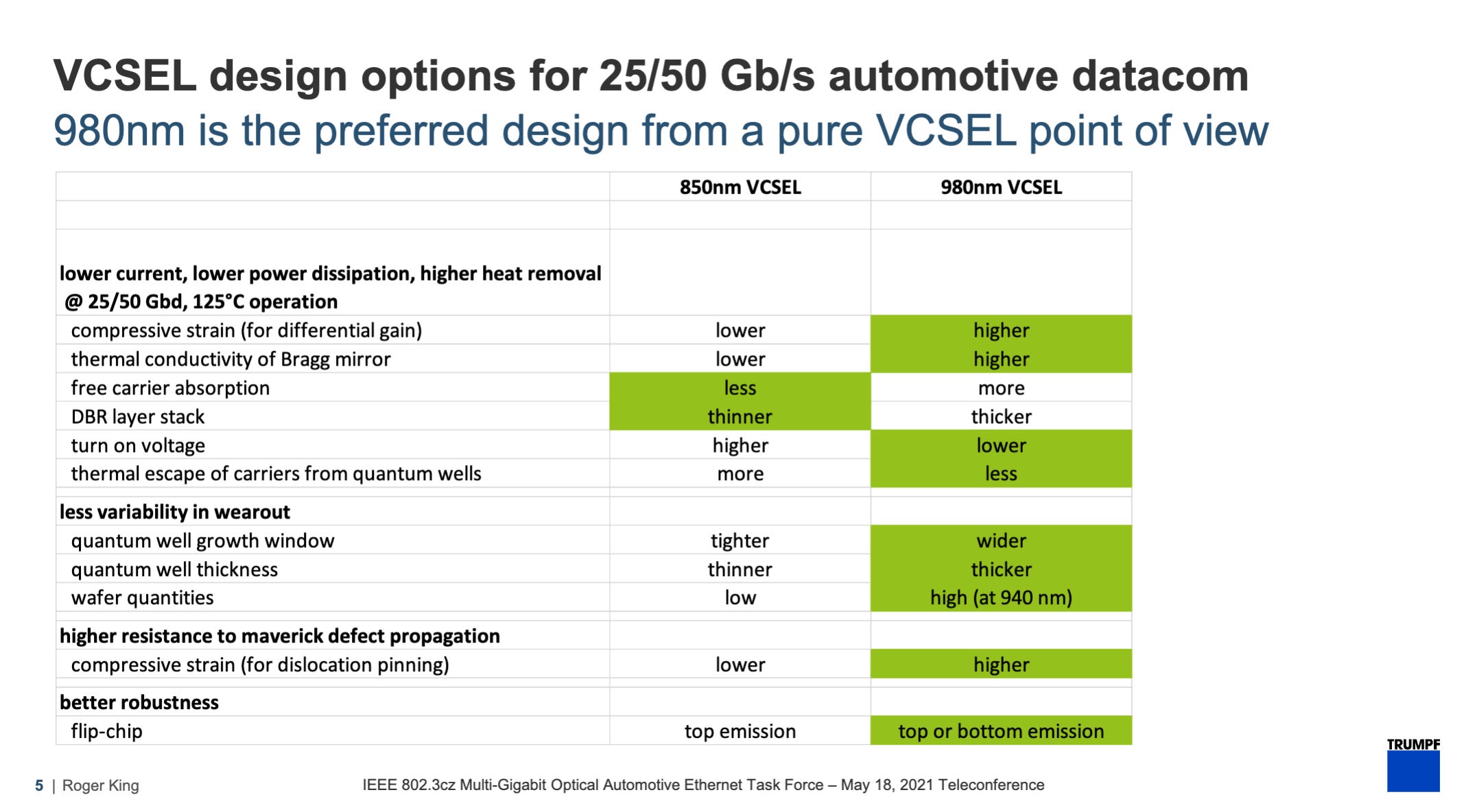
There are a lot of different aspects to whether VCSELs will ultimately become feasible. It is interesting to follow the developments here.
Intel had a Very Good Thursday
INTC 0.00%↑ Stock is up 10% into new all time highs. It’s mainly because of the news below, and also the fact that they hired Seok-Hee Lee, an SK Hynix veteran, who was ex-Intel incidentally, to lead advanced packaging and back-end engineering.
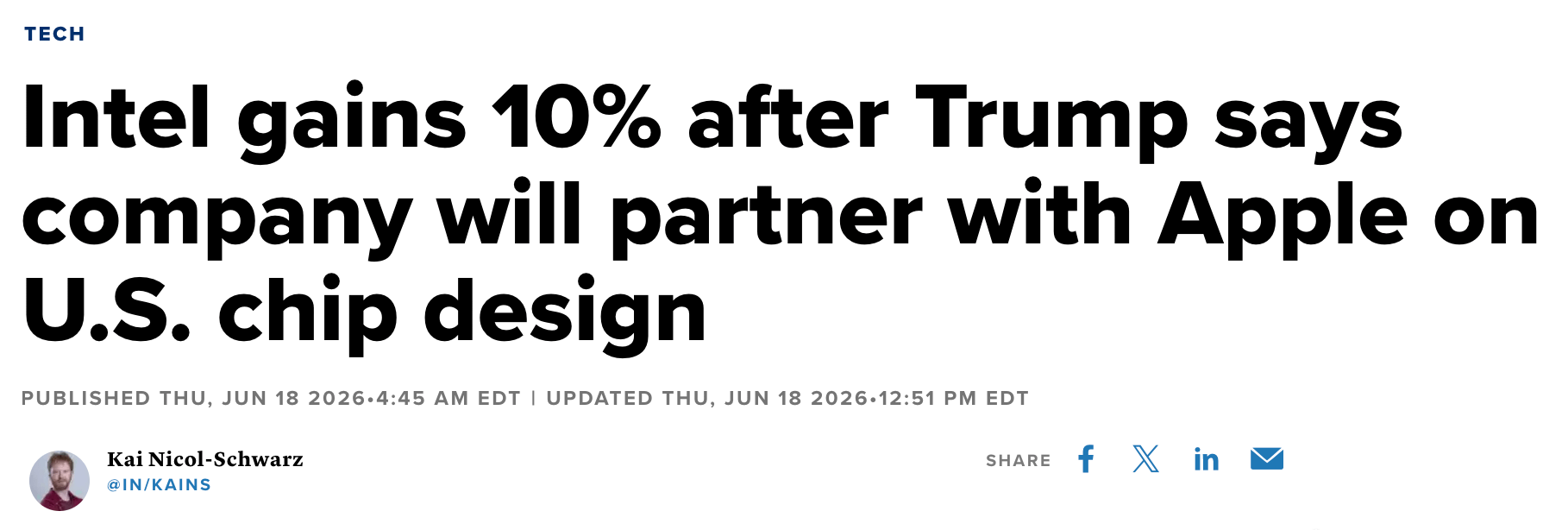
This is a major turnaround since Intel famously refused to manufacture iPhones for Apple because they didn’t think the market would be big enough. This primarily led Intel to miss the wireless boom, and handed over the keys to the mobile chips kingdom to TSMC.
Apple and TSMC have since built a massive business due to a long term partnership, where the business from just Apple alone was so much that it has made TSMC into what they are today. Apple going to Intel again for chips is opportunity knocking twice, at a time where Intel Foundry needs volume to pick up its foundry business whose near-death experience had many worried. TSMC’s capacity issues are now blowing fair winds Intel’s way again, and it’s time for Intel to orient their sails just right this time.
While reading your post, at least some former decision makers at Intel should slap themselves in the forehead repeatedly while exclaiming "That's for canceling Octane at exactly the wrong time! " .
That form of non-volatile memory was so durable (many, many write cycles) yet had low enough latences that it could be used like RAM in, for example, HANA servers.
Come to think of it, why isn't Intel thinking of restarting Optane?
Aside from that, enjoy Brighton and the UK!
PicoJools 200G VCSEL on GaAs changes the supply chain question for optical interconnects. If VCSELs deliver this bandwidth at scale, the constraint shifts from material scarcity to manufacturing yield. InP is not the only path anymore.