

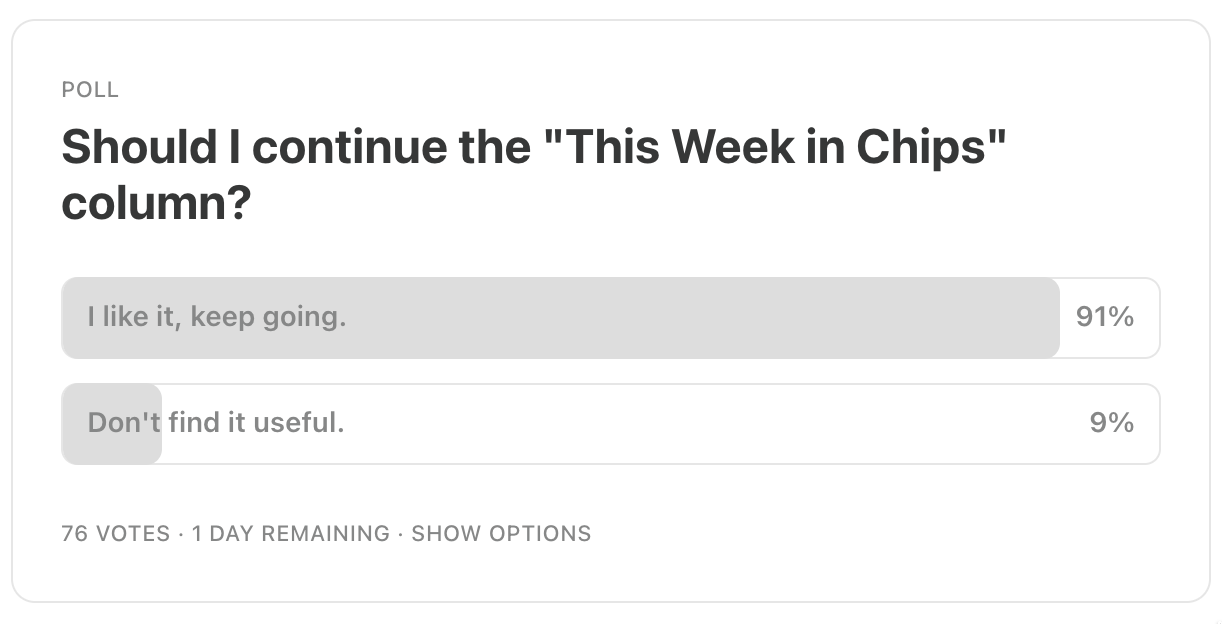
Here are the results of last week’s poll where I asked if I should continue this column. It seems like most of you like it, so let’s keep going.
Here’s some content from the past week in case you missed it.
Substack: GTC 2026 Preview | Implications of Nvidia’s SRAM-Decode Hardware on the Inference Market
Semi Doped Podcast: Optical Supply Chain: What would you buy? (also available on all podcast streaming platforms). We have a podcast being edited about the copper vs optical debate this week, which should be out shortly.
Lots to chatter about today. I’m experimenting with a slightly shorter format inspired by Construction Physics’ reading list posts. Let me know how you like it.
Nvidia’s $2B Optics Investment
Nvidia has invested $2B each into Lumentum and Coherent which are primary suppliers of lasers for datacenter topics. This investment is bullish for optics and is a direct signal that AI hardware makers are taking optics seriously. A lot of people assumed that this investment is to guarantee lasers for scale up optics, which has been all the talk of town ever since Lumentum’s last earnings call. In reality, Nvidia might be securing their CW laser supply for CPO or even optical circuit switches (OCS) for which Lumentum reported that they have a $400M backlog. Coherent serves as a great second source for all this.
(via The Next Platform)
Broadcom Call: Copper vs Optics
The AVGO 0.00%↑ earnings call was bullish with lots of revenue from AI semiconductors, but Hock completely stirred the hornet’s nest with this statement.
But I’m talking about scaling up in a rack, in a cluster domain. You really want to use direct attached copper as long as you can. And we are still based on our technology that Broadcom has with -- especially on connecting XPU to XPU or even GPU to GPU, we can do it with copper, and we can push the envelope from 100G to 200G to even 400G. We have SerDes now running 400G that can drive distance on a rack to run copper. Well, all I’m trying to say is you don’t need to go run into some bright shiny objects called CPO, even as we are the lead in CPOs. CPOs will come in its time, not this year, maybe not next year, but in its time.
While there has been so much news related to scale up optics, Hock’s view that copper will stay prevalent for scale up is a contrarian one. The claim that they have lab results at 400G/lane implies that copper scale up will continue into the 3.2T networking generation. The dissonance of large laser orders and the insistence of copper for scale up has confused many (including me). Maybe both copper and optics will coexist for a long time. I will plan on a deep-dive to investigate further.
(via Broadcom)
Credo Emphasizes Reliability and Long Life for AEC
CRDO 0.00%↑’s recent earnings call showed strong numbers from the specialist cable company. They doubled revenue from 2024 to 2025, and are expected to triple revenue in 2026. That’s 6x growth in two years. Following the money shows the copper is well and alive. They claim that 200G AEC is ready and has a reach of 5m. Their foray into optics is bring their “Zero Flap” system of link health and telemetry for scale out optics cables which is still the dominant method of hooking up racks. They claim that their Active LED cable (ALC) will fill the gap between copper and optics, with the cost and energy efficiency similar to copper, but with reach extending to 10m short-term, and eventually 30m.
(via Credo)
Micro-LED co-packaged optics cut power consumption to just 5% that of copper cables
TrendForce reports that micro-LED co-packaged optics (CPOs) achieve energy consumption of just 1-2 picojoules per bit compared to copper’s 10+ pJ/bit. The architecture integrates sub-50 micrometer micro-LED chips with CMOS driver circuits, delivering integration density exceeding 0.5 Tbps per square millimeter and supporting 800 Gbps and 1.6 Tbps transmission standards. Taiwanese manufacturers AUO, Innolux, and PlayNitride are building vertically integrated micro-LED production capabilities, positioning themselves as key suppliers for this emerging technology.
(via semiconductor-today)
Ayar Labs Closes $500M Funding Round Backed by Nvidia and AMD
Ayar Labs raised $500 million in a Series E round led by Neuberger Berman. The round values the co-packaged optics startup at $3.75 billion and brings total funding to $870 million. The company plans to accelerate development of CPO using the new funds to scale high-volume production and test capacity, and expand global operations. Their TeraPhy UCIe compliant solution is an optical I/O chiplet that can be dropped in next to a GPU or switch ASIC, enabling optical GPU-GPU or GPU-Switch links for AI scale up.
(via Ayar Labs)
INTC Chair of the Board Frank Yeary retires; Dr. Craig Barratt Takes the Helm
Frank Yeary’s retirement resulted in much rejoicing on X due his proposition a few years ago to split Intel’s business into product and manufacturing parts, and then sell off the manufacturing part. Many disliked this idea because Intel is a legendary company responsible for a large portion of the chip innovations in use today, and is the last bastion of US leading-edge semiconductor dominance. Dr. Barratt, who replaces him, has an engineering background and has decades of experience in Intel and Qualcomm. He is widely known for leading Atheros Communications, which was eventually bought by Qualcomm. Dr. Barratt seems to hold that view that Intel should be a world-class IDM.
(via Tom’s Hardware)
INTC Reportedly Reconsiders 18A for External Use, Hinting EMIB Could Generate Billions by 2H26
Intel CEO Lip-Bu Tan has reversed course on the 18A node, now viewing it as viable for external foundry customers after initially planning to reserve it for internal use and position 14A as the primary foundry offering. The customizable 18A-P variant is reportedly drawing strong interest. Yields remain limited but are improving monthly. Intel reaffirmed the 14A timeline with risk production in 2027 and volume in 2029. Perhaps most notably, Intel’s EMIB advanced packaging technology could generate billions in revenue starting as early as H2 2026, with reports suggesting NVIDIA may adopt EMIB for future GPU production.
(via TrendForce)
Memory stocks drop as US-Iran war threatens infrastructure and supply chains
Samsung Electronics and SK Hynix fell 10% as the Kospi index sank over 12% amid escalating US-Iran conflict. The selloff was driven by fears that prolonged conflict could disrupt energy supplies and shipping routes — nearly 20% of global oil flows through the now-closed Strait of Hormuz. Some news outlets mistakenly associated this with the SRAM-decode hardware expected to be announced at Nvidia GTC 2026 to be held next week.
(via SCMP)
Stuff I enjoyed reading this week
Broadcom Makes Lasers? — Austin Lyons has a nice piece comparing laser technologies between Broadcom, Lumentum, and Coherent.
Broadcom Is Not Likely To Fly On Those Big 2027 Forecasts — BTH has a skeptical view on AVGO’s recent earnings call, especially pushing back on Hock’s comments on the Customer Owned Tooling (COT) threat.
March Madness — Irrational Analysis is fun to read as always. I admire that he reversed his stance on optical clocking for Groq chips. More people should do this; stuff is complicated and its okay to change your mind.
The Cost of Staying — Amy Tam on X has an interesting thought piece on the opportunity cost of staying in a job you don’t like.
QCOM Robot — I had quite a laugh at what happens at the end of this video.
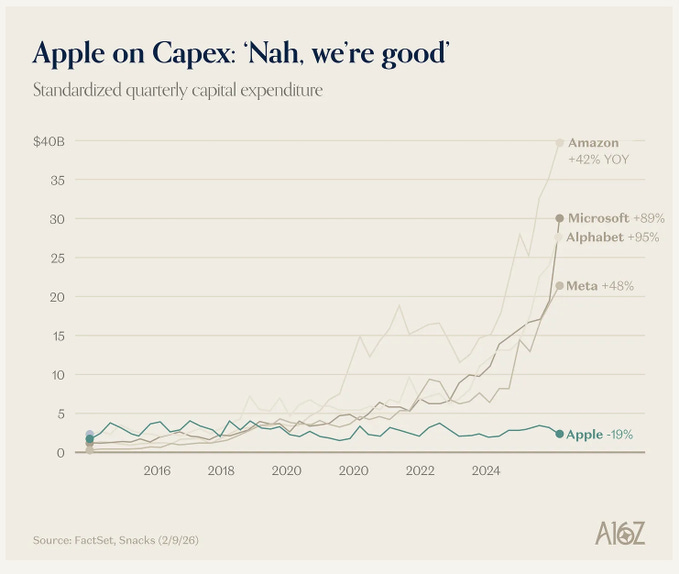
Finally, an interesting plot, via @JoshKale on X.
Have a great weekend!