

TurboQuant took the center stage this week — a Google research blog that showed up even though the paper has been on Arxiv for a year. The “Pied Piper” compression algorithm of the KV-cache world scared the memory industry into selling off stock.

I wrote up a quick note because a few people on the Substack chat wanted to know what TurboQuant is and what implications it has. I hear the article has made rounds in investor circles.

The other deep-dive from this week is on how grating couplers drive the future of TSMC COUPE for CPO, and why Himax has a fragile moat that will be quickly eroded by standardization of the COUPE-FAU interface.

If you missed the last Semi Doped podcast episode, you can check it out below.
After this podcast, I had a chat with the guys from Avicena, who were kind enough to explain the their tech to me in-depth. I will write a post once I understand what the industry’s hesitations are with MicroLED tech. Let me know if you have questions.
Lots of news. Let’s dive in.
Arm Ships Its First Chip Ever: ARM AGI
In its 35 year history, the AGI CPU is the first fully in-house processor built by Arm, and heralds a bold entry into the space of server CPUs at a time when agentic AI applications need it the most.
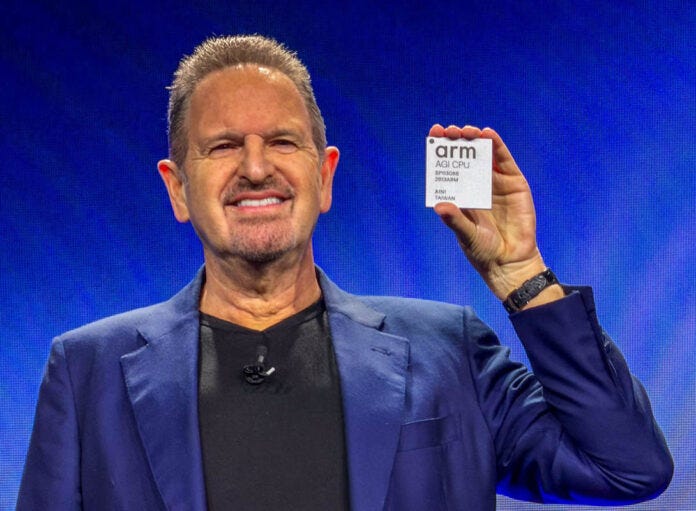
The AGI is built on TSMC 3nm with 136 Neoverse V3 cores, and 300W TDP. Their angle into the CPU market is power efficiency over x86 CPUs, which translates to better TCO when deploying at scale. Their high density air-cooled rack implementation can house 8,160 cores (60 CPUs) and liquid-cooled version can hold >45,000+ cores (>330 CPUs, >5x more).
Arm estimates that agentic AI will drive 4x more CPU utilization per deployed GW. As we saw with Vera Rubin, the CPU:GPU ratio is already 1:1 at the rack scale. Even if Arm is overestimating, that’s still a lot more CPUs. Like we predicted in an earlier post, the CPU:GPU ratio is about to get a lot higher from what we have been used to.
Meta is their lead customer for the AGI CPU, which will possibly run as head-node CPU for the rapid-fire MTIA chip releases planned in the coming two years.
CEO Rene Haas projected $15B in annual revenue from the chip within five years, with total company revenue reaching $25B and EPS of $9. In a Stratechery interview, Haas said memory (not TSMC) is the real bottleneck and his comments about the relative importance of core counts is interesting:
I think core count is going to be quite important because I think, again, I have a belief that each one of these cores will want to potentially run their own agent, launch a hypervisor job, launch a job that can be run independently, launch it, get the work done, go to sleep. The performance of the core is going to matter, no doubt about it, but I think the efficiency of that core is probably going to matter just as much as the performance is.
Digitimes noted that GUC is likely the first casualty of Arm selling chips directly, given its CPU work with Google and Meta. TechX is wondering when Qualcomm Oryon server CPUs will show up given that development was put on hold in favor of mobile chips during their lawsuit with Arm.
(via ARM)
CPU Shortage Gets Real: Intel and AMD Hike Prices
Arm’s CPU provides options at a time when Intel (INTC) and AMD are raising CPU prices again, up 10-15% since start of the year. Seemingly lead times have ballooned from ~2 weeks to up to 6 months for some SKUs. The question is whether this is a temporary supply hiccup (Intel’s CFO says Q1 was peak shortage) or a structural tightening as agentic AI workloads drive 4x more CPU demand per GW of data center capacity (per Arm’s Haas). Also, price hikes are a way to keep revenue up when supply is low and demand is high.

TSEM + COHR 400G/lane SiPho Using Si Modulators
Tower Semiconductor and Coherent jointly demonstrated 400 Gbps/lane data transmission using a silicon modulator built on Tower’s production-ready silicon photonics (SiPho) process, achieving a clear open eye at 420 Gb/s PAM4. Apparently, this was demonstrated in OFC 2026 which I could not go to, but would love to see the slides/paper if anyone from Tower or Coherent reading this wants to share.
If we look back at Broadcom’s recent 400G optical DSP announcement, there was a mention of thin-film lithium niobate (TFLN) used for the design of high bandwidth modulators required for the 3.2T generation of optical transceivers. If silicon modulators using micro-rings or Mach-Zehnder modulators (not sure which one was used) can work at 3.2T (400G ×8), then there is no need for special TFLN deposition steps in the wafer processing flow for several years to come. Since Tower is investing $920M in capex towards SiPho/SiGe capability, using existing infrastructure means high fab utilization rates. The modulators used Coherent’s InP CW laser, which requires narrow linewidth, low relative intensity noise (RIN) and low side-mode suppression ratios (SMSR) for it to work. Apparently, it’s good enough for 400G/lane.
(via Tower Semiconductor)
… Then GF Sues Tower
GlobalFoundries (GFS) filed patent suits against Tower Semi alleging that (emphasis mine):
… [Tower] has infringed GF patents by freeriding on decades of GF innovation with an intent to unlawfully take business away from the American chipmaker.
The ‘freeriding’ refers to 11 patents in areas related to smart mobile, automotive, aerospace and communications infrastructure. Yeah, so basically everything 😆 GF seeks to ban the import of Tower chips into the US, and be compensated for lost profits. Tower intends to put a stake in the ground and fight.
Tower shares closed down 7.5% and GlobalFoundries shares fell 4.6%. If you want to read too much into it, this infringement law suit comes after Tower’s deal with Nvidia to supply 1.6T optical transceivers. Lawsuits bad for everybody, except lawyers 🔱. Austin and I chatted about it in the upcoming Semi Doped episode. Stay tuned.
(via GlobalFoundries)
AAOI Lands Back-to-Back Hyperscaler Orders
Applied Optoelectronics (AAOI) received a $53M order for 800G single-mode transceivers from a major hyperscaler (likely AWS), with shipments starting Q2 and completing mid-Q3. This follows a $200M+ 1.6T order from the same customer the prior week. The stock jumped 20% on the news. The back-to-back orders across both 800G and 1.6T generations position AAOI as a meaningful supplier to at least one hyperscaler’s GPU cluster buildout, not just a niche player anymore.
(via Applied Optoelectronics)
Micron Crushes, Then Gets Crushed by TurboQuant
Micron (MU) posted a blowout FQ2: $8.05B revenue, record 75% gross margin, HBM sold out through end of 2026, and FQ3 guidance of $8.8B that blew past the $7.95B buy-side expectation. All good right? No.
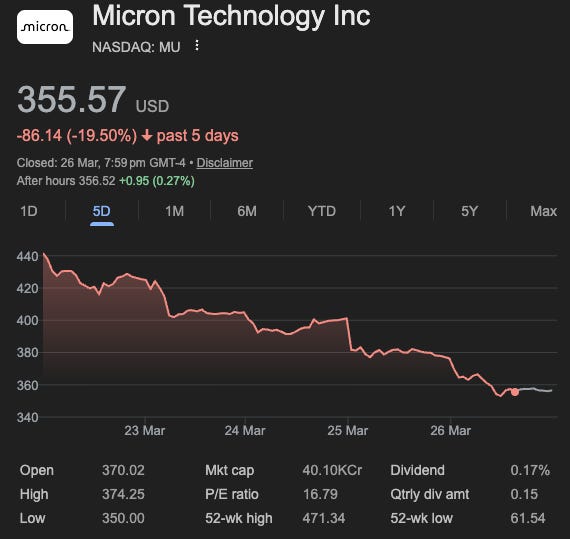
Google happened to resurface a year-old KV cache compression paper called TurboQuant and the stock cratered, down 25% from its highs by midweek with Sandisk dragged down 8% in sympathy. This is an overreaction to a year old paper, and nothing fundamentally changes the demand for memory and storage. More coverage in linked article above.
(via CNBC)
Helium Spot Price Surges 50%+ on Qatar Attacks
It’s not often we discuss raw materials in this newsletter, but this one is important. Iranian attacks on Qatar’s Ras Laffan LNG complex knocked out roughly 17% of Qatar’s LNG export capacity, triggering a 50%+ spike in helium spot prices. Also, remember that Helium is a finite resource on Earth that when wasted is lost forever because it leaves the atmosphere and escapes into space. Why does this matter other than for birthday balloons?
Helium is critical across implantation, lithography cooling, and leak detection in semiconductor manufacturing. Helium’s inertness is good for purity testing, and its small atomic size is useful for leak testing where Helium goes through but not other gases. It’s not a major component, but supply disruption is a concern. Samsung and SK Hynix are most exposed (sourcing 64.7% from Qatar versus TSMC’s 30%) and are stockpiling at elevated prices. Sure Helium is recycled after use, but still needs replenishig.
The crisis is compounding broader materials cost pressure: photolithography solvents are up 40-50%, and suppliers including DuPont and LG Chem have issued price hike notices for April. The main issue is the medium to long term implications of Helium supply because disruptions often take years to recover.
(via Trendforce)
Have a great weekend!