

It’s been an incredible year, and the statistics below only scratch the surface of what an unbelievable journey it has been! I want to keep this short, as I imagine you have a flood of recaps in your inbox already.
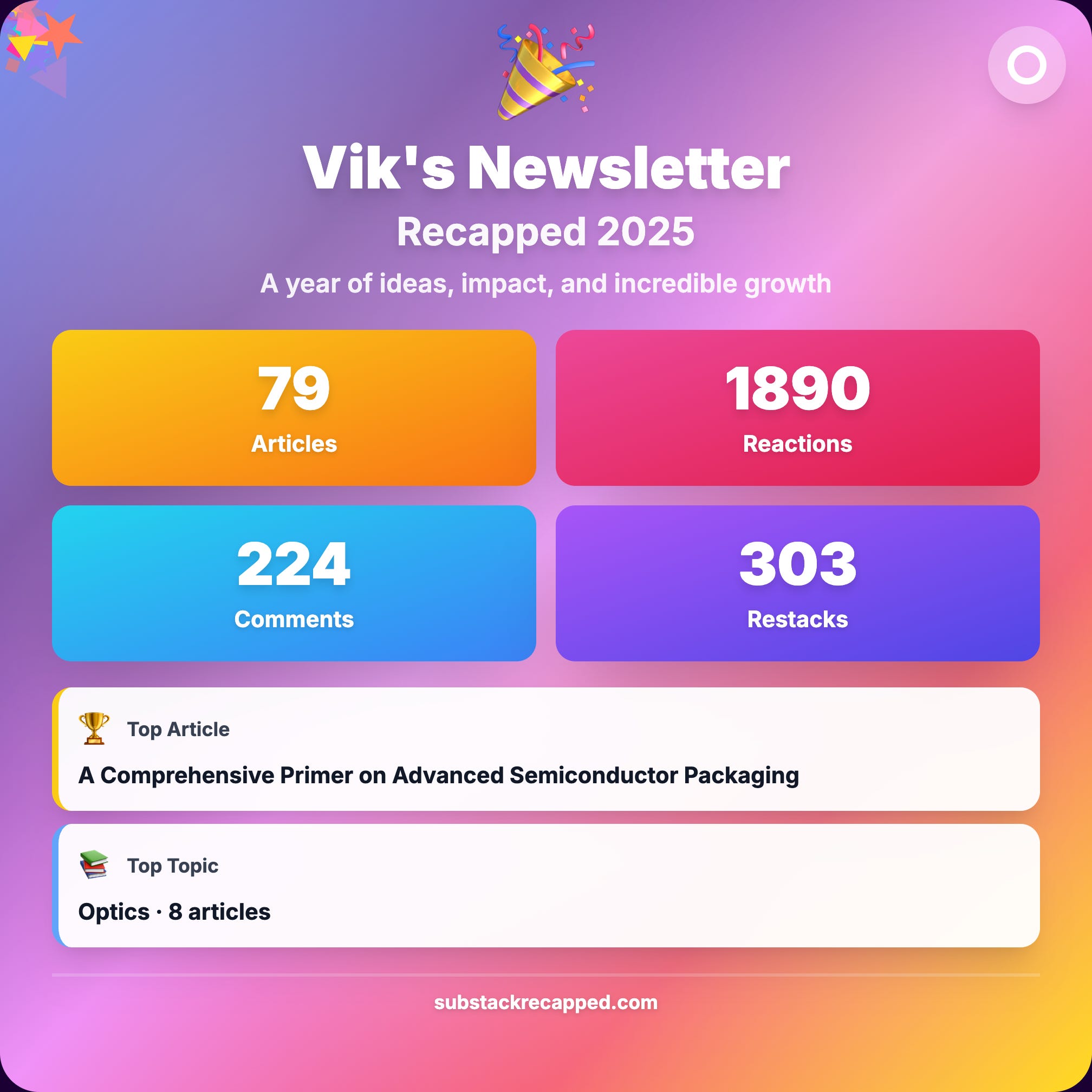
As we turn the page into 2026, this Substack turns 2 years old. My sincere thanks to everyone who supported my work by signing up, or upgrading to a paid subscription. Your support has put this newsletter at #63 in the best selling technology publication list on Substack, as of this writing. None of this is possible without you. I am really grateful.
If you’re a free subscriber, thank you for sticking around, and now is a great time to upgrade because I have big plans for the newsletter in 2026, which requires a big increase in subscription pricing.
By upgrading now to an annual plan, you’ll be grandfathered in forever and will have the best possible rate for this newsletter ever!
Details of new pricing structure will be announced on Jan 4, 2026. More details about the reasons for the change and future plans will be explained.
As a paid subscriber, you’ll have an early bird advantage forever by renewing your subscription for 2026. If you’re on a monthly plan, upgrading to an annual one gives you the best possible discount. Thank you for trusting me at the start of my journey.
Effective immediately, I have discontinued all student and purchasing parity discounts for two reasons:
Calculating currency parity every time is difficult for me, but I really appreciate everyone who signed up from various parts of the world.
Making educational content on my YouTube channel (a work-in-progress) is a better choice because it is completely free. The explainer parts of my paywalled posts will be free to read anyway - and that way, you’ll still get a bulk of the educational benefit without having to pay.
If you already have these discounts, they will continue to be valid as long as you hold on to your current subscription, or you lose access to your edu account as a student.
More statistics for 2025
The Substack has grown from 4,600 to 10,250+ total subscribers.
This is my first year of going paid, and I have a “healthy” conversion rate.
This recap is my 80th post in 52 weeks: an average of 6 posts per month. I easily average 2,500 words a post. That makes it 200K+ words written or well over two full length books this year.
Most liked (109), and viewed (13.2K) post is “A comprehensive primer on advanced semiconductor packaging”
Post that added most subscribers (+170), and that drove most paid conversions (+41) is “A beginners guide to interconnects in AI datacenters”
The easiest post I wrote all year (took ~6-8 hours) that drove a surprising amount of ARR (>$4,000) is “CPO fears, Credo, and the role of AEC in 1.6T networking”
The most discussed post with a lot of comments is a tie between “What chip design can learn from supersonic jets” and “How AI demand is driving the memory supercycle”
10 personal reflections from writing a Substack in 2025
Longer posts are not necessarily better:
A post needs to address a specific problem.
Subscription rates are not tied to post length; insights that are often overlooked or misunderstood are valuable
More lower word-count insightful posts are generally more impactful than a single longer post + summary. I want to do more of the former.
Many readers use AI to help them understand my post; I should do a better job of explaining at a basic technical level so that they don’t need to do that.
Investors want to understand semiconductor technology to make better business decisions. Their paid subscription gives tangible value by helping them make more money. I did not anticipate this angle when I started this newsletter.
I like making videos even if I am not a good speaker on camera. It’s cringe when I see it, but I don’t mind. I HATE editing videos; I’d rather pay someone to do it.
I traveled to 4 conferences (PhoWest, ISSCC, IMS, IEDM) in the US this year while living in India. Travel time (1 day each way) and jet lag imposes an incredible strain on body and mind. Conference travel is expensive but paid subscriptions cover my expenses and improves the quality of what I write. So it’s worth it, and I want to do even more in 2026.
I don’t like paywalling because all that effort I have put in reaches hundreds of people instead of >10,000, but it drives paid conversions and is the only way to have a sustainable newsletter business. Stealing from the copper vs. optics debate for interconnects:
Freely share when you can, paywall when you must.
Social media is an integral part of newsletter writing; the traffic engine it provides necessary marketing for your work. I have met so many interesting people through it.
Remember to be supportive of others’ work. They are grinding just like I am.
Hard work wins over scammy techniques to grow my Substack; try to provide something of genuine value.
My readers are my biggest asset. Treat them with respect because they could be anywhere in the whole wide internet. But they chose to be with me.
I think 2026 will have a lot of interesting developments in the field of optics and photonics. It is good if people understand the jargon around it. As a token of gratitude for your support, I am removing the paywall from both the text and video essays of the post on optical transceiver nomenclature. I hope you like it!


If you are interested in previous “Year in Review” posts, here is last year’s:

nice! you're going to crush it next year too