

This is the third article in the series on UHP lasers for CPO/NPO. If you want to understand why these external UHP lasers are needed for CPO, see this post for background.
Why Co-Packaged Optics Uses External Lasers Instead of Integrated Sources

Welcome to a 🔒 subscriber-only deep-dive edition 🔒 of my weekly newsletter. Each week, I help investors, professionals and students stay up-to-date on complex topics, and navigate the semiconductor industry.
In Part 1 of this series, we built up the fundamental physics of ultra high power (UHP) lasers. We concluded by identifying the four walls that make it challenging to implement a UHP laser: managing heat, maintaining narrow linewidth, getting light out, and catastrophic optical damage.
Lasers for CPO/NPO: Part 1 – The InP DFB Laser

There is a lot of FUD in the market about ultra high power (UHP) lasers for CPO and who the leading provider is in this segment. Everybody I’ve asked about UHP lasers unequivocally says Lumentum is in the lead, but few are able to discuss the engineering challenges in making UHP lasers, where the Lumentum advantage lies (if it even exists), and what the real alligator-filled moat is that keeps competitors out.
In Part 2, we explored how Lumentum overcame these challenges via their 2007 paper as JDS Uniphase, and via their later 2022 CLEO paper on UHP lasers. We also looked at how defensible their high power laser platform is.
Lasers for CPO/NPO: Part 2 – Lumentum’s Technology and Moat

In this series on UHP lasers for CPO/NPO, our purpose is to carefully dissect the technology to understand how it works, where the engineering difficulty lies, what architectural options exist, and deeply understand where the technology differentiation and moat actually lies for key industry players. If you want to understand why these external lasers are needed, see this earlier post.
In Part 3, we will look at the use of a Semiconductor Optical Amplifier (SOA) in conjunction with a lower power laser (~100 mW) to generate UHP laser power levels of ~400 mW. This architecture is called the Master Oscillator (the laser diode), Power Amplifier (or the SOA) approach – aka, MOPA. We will contrast it to the single-cavity UHP laser approach to highlight the pros and cons of each.
Contents:
The MOPA Concept (free)
Integrated Semiconductor Optical Amplifiers (SOAs)
Operating Principle
Amplified Spontaneous Emission (ASE)
Back Reflection into the SOA
MOPA High Power Lasers
Sumitomo’s SOA-Integrated DFB Laser
Nanjing University’s 12-Channel MOPA Array
Single Cavity vs MOPA: Lumentum vs Sumitomo
Who is Actually Shipping?
Which Bet Wins
By reading this post, you agree to the terms and conditions. Also see the full ethics statement.
If you’re new, check out the About page. A lot of readers expense the subscription to this newsletter as it helps their professional work. Group subscriptions (3+) are 20% off. If you have any questions, reply to this email and let me know!
Check out the Semi Doped podcast and our daily free newsletter with latest semi news. Reach out for institutional research at SemiExponent.
The MOPA Concept
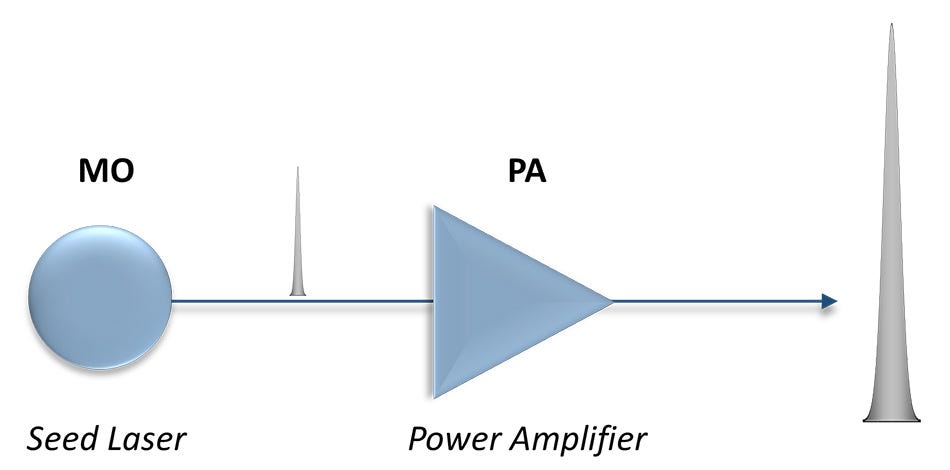
The idea is simple: instead of making a single-cavity high power laser that is prone to issues like spatial hole burning and optical damage like we’ve discussed in previous articles, use a low power seed laser, and then put a power amplifier after it to boost up the power.
Source: Coherent
Example: A MOPA UHP laser can run the MO at ~100 mW and have the PA multiply that power by a factor of 4x, or 6 dB, to produce a total of ~400 mW at the output.
It is far simpler to make a low power laser with good spectral qualities due to the photon field in the cavity being low. A lot of the issues we discussed earlier in making UHP lasers are greatly mitigated at low laser power. Most laser manufacturers can make them at high yield.
The challenge in MOPA lasers comes from designing a power amplifier (SOA) that is good enough to boost the power to the levels needed for CPO, without degrading the spectral properties of the signal. High power amplification, whether it is radio waves or light, is no laughing matter.
When amplifiers are driven to deliver high power, they unintentionally degrade the quality of light output unless they are designed well. Having two components instead of one introduces other problems: (1) the interface between the two matter, and (2) the combination of the MO and PA should work reliably at high yield over a range of temperatures.
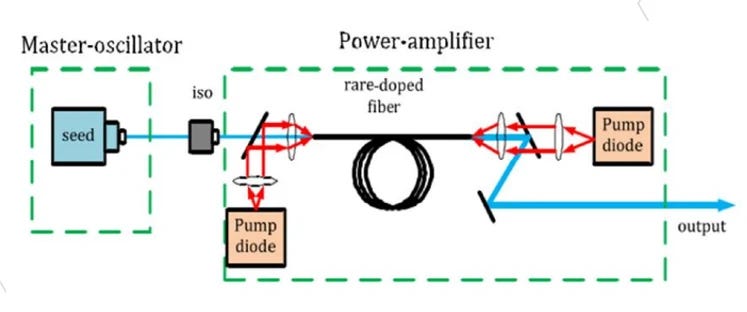
The concept of MOPA amplifiers is not new as they have been widely used in precision cutting, lidar and medical imaging. Those systems use discrete laser and amplifier components, along with isolators, focusing lenses and mirrors. The isolator exists to prevent the reflected light from the input of the PA from affecting the operation of the MO. This is important to remember when we discuss integrated MOPA lasers. Fibers doped with rare earths like Erbium or Ytterbium perform the power amplification, which themselves require pumping with lasers to amplify light. Mirrors and lenses guide the light across the system.
Source: em-smart.com
Discrete MOPAs are too bulky for use as light sources for CPO. They will need to be integrated into the same InP substrate to deliver a compact light source. We will discuss integrated SOAs next.