

My cerebro-sphere has been mostly occupied by Tau Scaling this week. Tau Scaling to the first order is a hybrid bonding story, and sets a precedent that will soon drive the industry to start stacking logic chips, even if EUV is available. Check out the deep dive below for more thoughts. We also have a ton of podcast content on lithography and Tau Scaling.

What’s left of my grey cells have been deployed into thinking about interconnects. I have a deep dive piece on how power density is driving up active copper cable use; link below in case you missed it. I believe we’re still in the early phase on this one.

Today’s short post is about a strange contradiction in the argument about what the right laser source for CPO is: a single high power laser, or a wavelength multiplexer, multi-color laser. I believe either one is viable, and we will explore why.
A quick note: I will at Computex 2026 in Taipei next week, and posting might be light while I attend the conference. If you are attending and happen to see me, say hi! 👋🏽
There has been a lot of recent news about Sivers Semiconductor, whose stock has shot up about 2,000% based on their optics business lines for CPO. First thing to note is that their optics business is a minority; their main business is RF, wireless, and phased array antennas for Satcom. I’m surprised more people aren’t talking about them as a potential acquisition target by SpaceX post-IPO – because that’s where their real strengths lie. I’m still not convinced that there’s going to be a Satcom boom post-IPO, so let’s move on.
The other argument I’ve seen is that Sivers’ approach to CPO is inherently flawed, because the use of wavelength division multiplexing (WDM) is worse than using a single powerful external laser.
To explain this further, you should know that there are two schools of thought:
Ultra High Power Laser: The idea here is to just create a really powerful laser and keep it external to the rack. Once it reaches the optical engine, you split it up into parallel lanes and modulate each lane with data on a SiPho chip. Coherent showed a 400mW UHP laser, and Lumentum showed an 800mW-1W “Super High Power” (SHP) laser.
CW-WDM Laser: The other approach is what folks like Sivers and Ayar Labs are adopting. The light source itself is multi-color from the start with each color having about 50-65mW. Across 8 lanes, that is still 400mW total but you don’t have to split it up at the optical engine. Since you have different light colors, you can modulate each one with data.
But is the WDM approach to CPO really worse than UHP lasers? It is also important to note that Lumentum, often touted for their SHP lasers, also have a CW-WDM laser which is really very good: 8 wavelengths, each up to 100 mW. There is a whole multi-source agreement (MSA) around CW-WDM too.
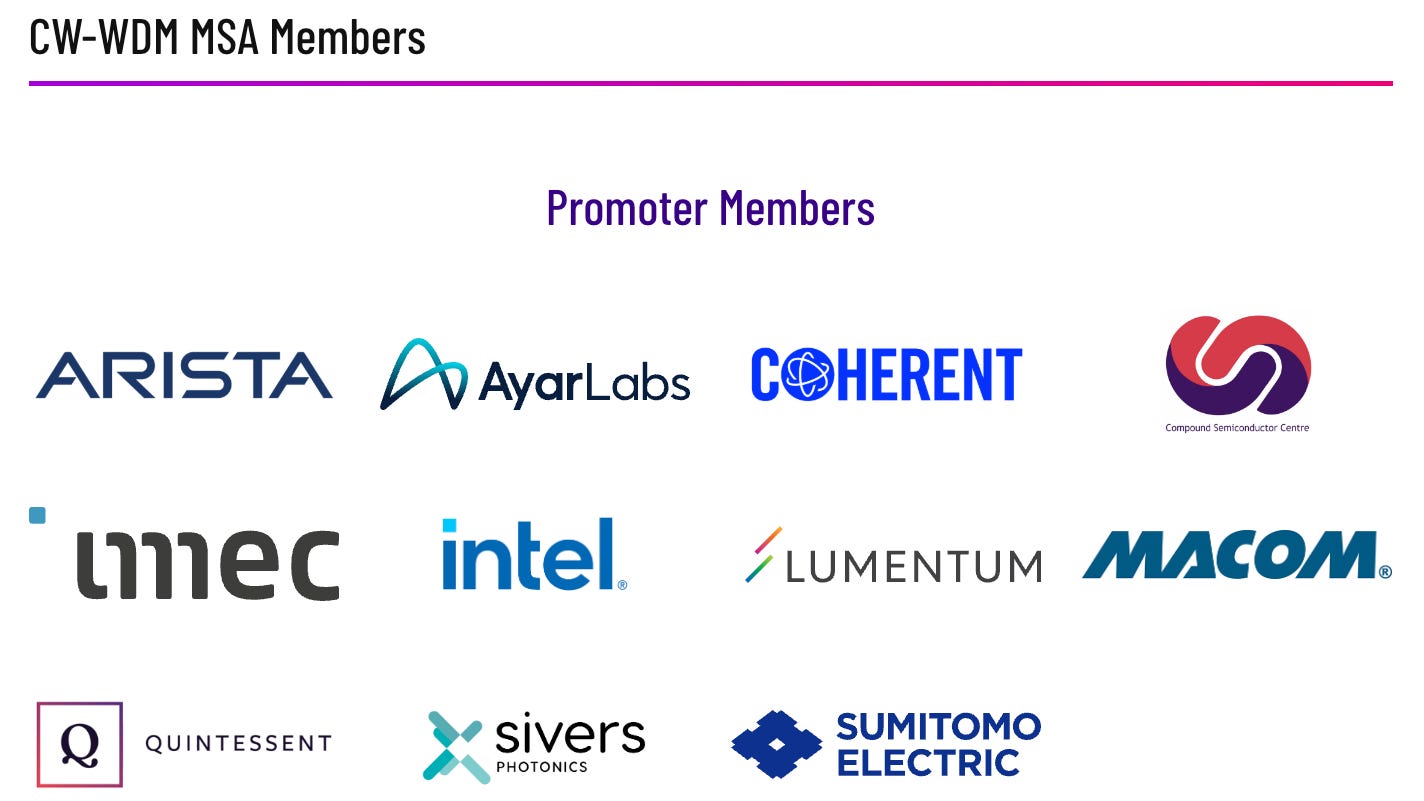
If CW-WDM is so flawed from the start, why does Lumentum have a product here, and why are they part of the MSA? Note that Coherent is on here too. See the contradiction here?
The real answer is that UHP lasers vs WDM lasers are just two different ways of solving the same problem, and Lumentum is hedging its bets on which architecture will win by having both. Here’s why:
The SHP laser approach needs 800mW because it is going to be split up into multiple lanes on the other side. For this, there should be substantial power available for each lane after the split. Let’s take a more “ordinary” UHP laser like the one from Coherent for comparison running at 400mW, single color. Assuming no loss through the channel for simplicity, 400mW gives 50mW per channel across 8 lanes.
If you see Sivers’ WDM lasers across 8 lanes, each one has 50mW per channel. No difference at the modulator level compared to the single color UHP laser approach.
You can roughly see how they are equivalent. If you really want to take loss into account, remember that a single UHP laser needs a 1:8 which a WDM approach does not. This adds to the loss budget and requires a higher power laser to start with. WDM instead has to deal with multiplexer/demultiplexer loss. Problems on both sides.
Using a WDM approach means that you can transmit more data on a single fiber, whereas UHP lasers after splitting need different fibers. WDM has bandwidth density that split UHP lasers do not.
What matters is how much laser power is available at the modulator ultimately, and not how much power is available at the external laser source. Running 800mW in a single laser also presents cooling problems, while running 8 lanes at lower power makes thermals easier to manage on a per laser basis.
Higher laser power isn’t a virtue in itself as a lot of commentary on optics makes it out to be. Higher power is good for SNR and BER. But more power also means more heat, which is one thing that lasers explicitly dislike because their lifetimes drop like a rock at higher temperatures. Even if the laser is external to the rack, reliability is one thing that CPO adopters still worry about the most (data from conferences shows that lasers do okay, but no info is available at scale yet).
The real danger to Sivers is not the use of their WDM approach, but instead Lumentum beating them at their own game with higher quality WDM lasers.
Comparison table with reported numbers

Have a great weekend!
The structural question underneath the laser architecture debate is which approach can actually be manufactured at CPO scale.
Both UHP and WDM lasers depend on the same InP epiwafer substrate capacity. There are roughly 5 qualified suppliers globally for the active region epitaxy, and lead times are stretching as AI interconnect demand compounds. The laser architecture question may resolve itself not on technical merit but on who can deliver volume within the next 18 months.
Lumentum's hedge (having both products) makes structural sense for exactly this reason: they are buying optionality on the substrate supply chain, not just on the laser design.
Worth watching which architecture achieves the first 100K unit production run. That will tell you more than any technical comparison.